
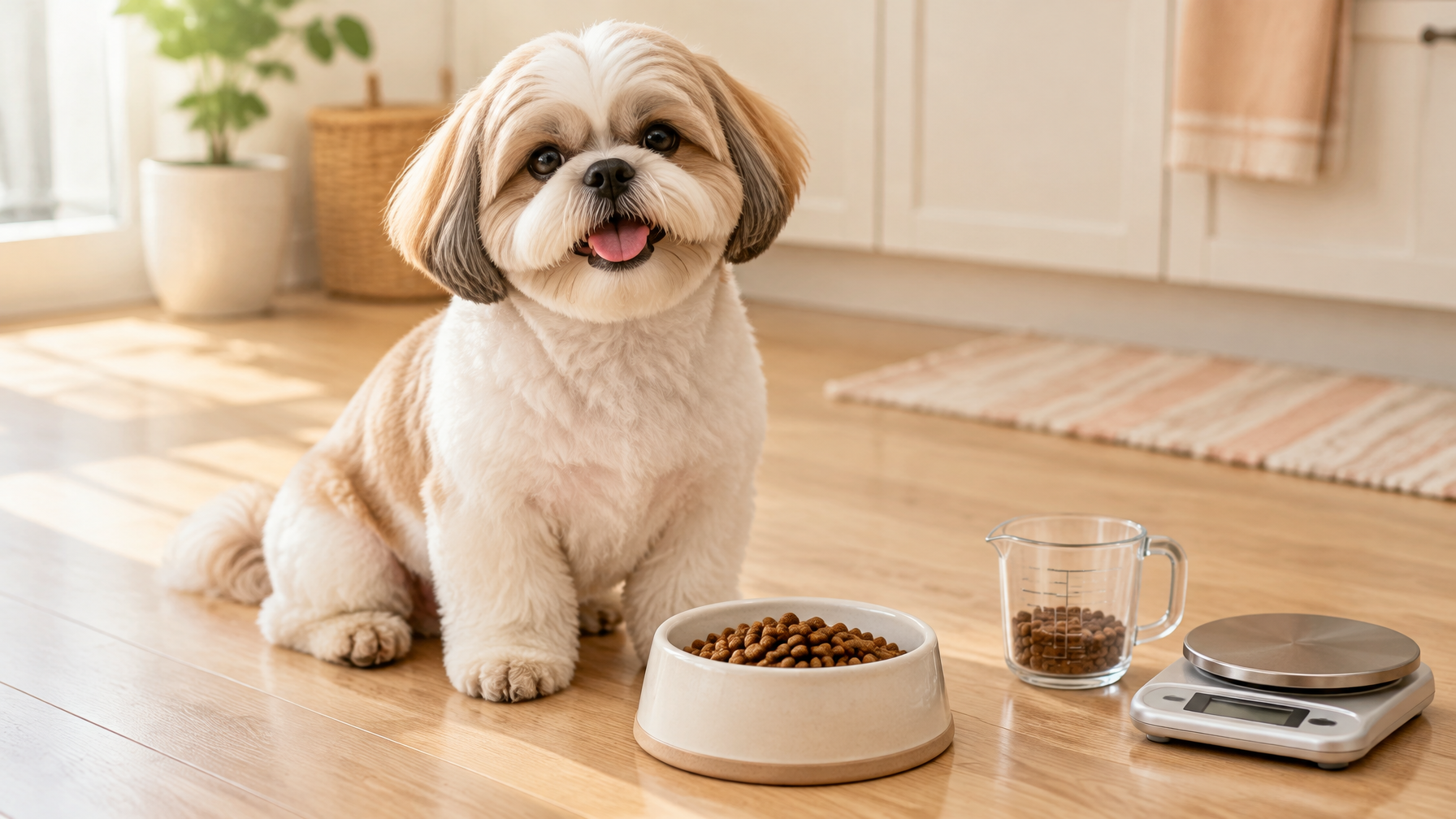
Most adult Shih Tzus (9–16 lb) need roughly 240–500 calories a day, depending on weight, activity and whether they’re neutered. Divide that by the calories per cup on your dog food label to get the daily amount, and split it into two meals. Puppies need three to four smaller meals a day to help prevent low blood sugar. Treats should stay under 10% of daily calories.
- Adults: about 240–500 kcal a day
- Adults: 2 meals a day
- Puppies: 3–4 meals a day
- Switch to adult food around 1 year
- Treats: under 10% of calories
- Your vet sets the final number
Most dog food bags give a feeding range so wide it’s barely useful for a 12-pound dog, and Shih Tzus gain weight easily. A few extra kibbles a day add up fast on a small body.
This guide shows you how to work out a real starting amount for your Shih Tzu using the same method vets use, how often to feed at each age, and how to tell whether the amount is right.
From my own dogs: Working out what to feed, and how much, was one of the early mistakes I learned from. Feeding a 5-year-old Shih Tzu alongside a 7-year-old Himalayan Sheepdog makes it very clear that portion advice for “dogs” means almost nothing. A small dog’s needs have to be worked out on their own.
01
How many calories does a Shih Tzu need a day?
A typical neutered adult Shih Tzu needs roughly 320–500 calories a day, and a less active one roughly 240–430, depending on body weight. These are starting points; your vet adjusts them for your dog.
Vets estimate calories in two steps. First, the resting energy requirement (RER), using the formula published by the Pet Nutrition Alliance: RER = 70 × (body weight in kg)0.75. Then they multiply it by a factor for life stage and activity, for example 1.6 for a neutered adult, 1.2–1.4 for an inactive or weight-gain-prone dog, and 1.0 for weight loss.
| Adult weight | Weight loss (1.0 × RER) | Less active (1.2–1.4 × RER) | Neutered adult (1.6 × RER) |
|---|---|---|---|
| 9 lb (4.1 kg) | ~200 kcal | ~240–280 kcal | ~320 kcal |
| 10 lb (4.5 kg) | ~220 kcal | ~260–305 kcal | ~350 kcal |
| 12 lb (5.4 kg) | ~250 kcal | ~300–350 kcal | ~400 kcal |
| 14 lb (6.4 kg) | ~280 kcal | ~335–390 kcal | ~450 kcal |
| 16 lb (7.3 kg) | ~310 kcal | ~370–435 kcal | ~495 kcal |
Which column fits your dog?PetMD notes that Shih Tzus tend to gain weight because they aren’t very active. Many pet Shih Tzus land closer to the “less active” column than the neutered-adult one. Start in the middle, weigh your dog every couple of weeks, and adjust. Your vet can confirm the right target for your dog’s age and health.
The breed standard from the American Shih Tzu Club puts the ideal adult weight at 9 to 16 pounds. If your dog is outside that range, ask your vet what their ideal weight is, and calculate from that rather than from their current weight.
02
How do you turn calories into cups of food?
Divide your dog’s daily calories by the “kcal per cup” printed on the food label. That gives you cups per day; then split it into meals.
- Find the calorie content on the bag. It’s listed as “kcal/cup” or “kcal/kg.” Every food is different, which is why a single “cups per day” chart can’t be accurate.
- Divide daily calories by kcal per cup. For example, if your dog needs about 300 kcal and the food has 350 kcal per cup: 300 ÷ 350 ≈ 0.86 cup a day.
- Split it into meals: about 0.43 cup per meal for an adult on two meals.
- Subtract treats. If your dog gets treats, reduce meals slightly so the daily total stays the same.
- Measure properly. Use a real measuring cup, or better, a kitchen scale. A “cup” scooped by eye can easily be off by a meaningful amount for a small dog.
The numbers above are an example onlyCheck your own food’s label. Calorie density varies a lot between brands and formulas, so the same “cup” can mean very different amounts of food.
03
How often should a Shih Tzu eat at each age?
Shih Tzu puppies need three to four small meals a day to help prevent low blood sugar. Adults do well on two meals a day. Switch from puppy to adult food gradually, around 1 year old.
| Age | Meals per day | Food type | Notes |
|---|---|---|---|
| Puppy (up to ~1 year) | 3–4 | Small-breed puppy food | Frequent meals help prevent low blood sugar |
| Around 1 year | 2–3 | Gradual switch to adult food | Mix old and new food over several days |
| Adult | 2 | Balanced small-bite adult food | Watch weight; Shih Tzus gain easily |
| Senior | 2 | Ask your vet | Needs can change with age and health |
Why puppies need frequent meals
According to PetMD, Shih Tzu puppies are at risk of hypoglycemia (low blood sugar), so they need frequent meals. Well-formulated small-breed puppy foods, which tend to be higher in fat, protein and complex carbohydrates, help lower that risk.
Puppy warning signsIf your puppy seems weak, wobbly, trembling or unusually sleepy, especially after missing a meal, call your vet right away. Low blood sugar in a small puppy can become an emergency quickly.
Puppy calories
Growing puppies need far more calories per pound than adults. The Pet Nutrition Alliance lists growth at 2 to 3 times RER, with needs starting to decrease from around 4 months of age. Because growth needs change so quickly, follow your puppy food’s guide for your puppy’s current weight and have your vet check growth at each visit.
Feeding is one piece of Shih Tzu care
Coat, health, gear and grooming: everything a Shih Tzu owner needs, in one place.
Explore the complete Shih Tzu guide04
What kind of food is best for a Shih Tzu?
A complete and balanced small-bite food that meets AAFCO guidelines. PetMD notes dry kibble’s abrasive texture can help remove some plaque, which matters for a breed prone to dental disease.
- Complete and balanced. Look for an AAFCO nutritional adequacy statement on the bag. PetMD notes that if a food meets AAFCO guidelines, a dog usually doesn’t need extra supplements unless your vet recommends them.
- Small bites. PetMD recommends a small-bite diet for adult Shih Tzus. Small kibble suits a small, short muzzle.
- Dry kibble for dental support. PetMD notes dry kibble is abrasive and can remove some plaque buildup, and Shih Tzus are prone to periodontal disease. It’s a help, not a replacement for brushing teeth.
- Life stage. Use puppy food until around 1 year, then adult. Breed-specific Shih Tzu formulas exist, but any complete and balanced small-breed food can work.
- Change foods slowly. Mix increasing amounts of the new food into the old over several days to avoid an upset stomach.
For tooth brushing and dental care, see the teeth section of our Shih Tzu grooming guide.
05
How many treats can a Shih Tzu have?
Treats should make up less than 10% of daily calories. For a Shih Tzu, that’s roughly 24–40 calories a day from treats, according to WSAVA’s guide for healthy adult dogs.
| Dog’s body weight | Maximum daily treat calories (WSAVA) |
|---|---|
| 4 kg (about 9 lb) | 24 kcal |
| 6 kg (about 13 lb) | 32 kcal |
| 8 kg (about 18 lb) | 40 kcal |
That’s not much. Many commercial treats and dental chews contain enough calories to use up a small dog’s whole allowance in one go, so check the label. PetMD points out that treat calories “can add up fast” in a small breed.
- Break treats into small pieces. Your dog cares about how often they get a treat more than how big it is.
- Use part of their daily kibble as training rewards.
- Count dental chews as treats.
06
How can you tell if your Shih Tzu is overweight?
You should be able to feel the ribs easily under a thin layer of fat and see a waist from above. A Shih Tzu’s coat hides weight gain, so check with your hands, not your eyes.
PetMD notes that obesity in Shih Tzus can contribute to diabetes, arthritis, heart disease and breathing difficulty, which is a real concern for a flat-faced breed.
- Feel the ribs. Run your hands along the sides. You should feel the ribs without pressing hard.
- Check the waist. From above, there should be a visible tuck behind the ribs. Part the coat or check after a bath, when the coat is wet.
- Weigh regularly. A small change on the scale is a big change for a small dog.
- Keep them moving. PetMD recommends 20–30 minutes of controlled exercise daily. Avoid hot weather, since flat-faced dogs overheat easily.
- Ask for a body condition score at vet visits. It’s a simple hands-on check of whether your dog is underweight, ideal or overweight.
Extra weight puts more strain on a Shih Tzu’s knees, back and breathing. Read more in our guide to Shih Tzu health issues.
FAQ
Shih Tzu feeding FAQs
How much should a Shih Tzu eat per day?
Most adult Shih Tzus need roughly 240–500 calories a day depending on weight and activity. To turn that into food, divide the calories by the kcal per cup on your food label. For example, 300 kcal of a food with 350 kcal per cup is about 0.86 cup a day, split into two meals.
How many times a day should I feed my Shih Tzu?
Adults do well on two meals a day. Puppies need three to four smaller meals a day to help prevent low blood sugar, according to PetMD.
When should a Shih Tzu switch to adult food?
Around 1 year old. Make the switch gradually over several days by mixing increasing amounts of adult food into the puppy food.
How much should a Shih Tzu puppy eat?
Puppies need more calories per pound than adults, and their needs change quickly as they grow. Follow your puppy food’s feeding guide for your puppy’s current weight, split it into three or four meals, and have your vet check growth at each visit.
How many treats can a Shih Tzu have a day?
Treats should stay under 10% of daily calories. WSAVA’s guide puts that at about 24 calories a day for a 4 kg (9 lb) dog and about 32 for a 6 kg (13 lb) dog.
Is dry or wet food better for a Shih Tzu?
Both can be complete and balanced. PetMD notes dry kibble’s abrasive texture can help remove some plaque, which is useful for a breed prone to dental disease, and recommends a small-bite diet. Ask your vet if your dog has special needs.
Sources
- Shih Tzu Dog Breed: Health, Care and Lifestyle (PetMD)
- Calculating Calories Based on Pet Needs (Pet Nutrition Alliance)
- Feeding Treats to Your Dog (WSAVA Global Nutrition Committee)
- The Illustrated Guide to the Shih Tzu Standard: Size and Substance (American Shih Tzu Club)
Update log
- October 9, 2026: Published. Calorie estimates calculated with the Pet Nutrition Alliance RER formula and factors; treat limits from WSAVA.
This is general information, not veterinary advice. Consult your vet before making changes to your dog’s diet or care.