
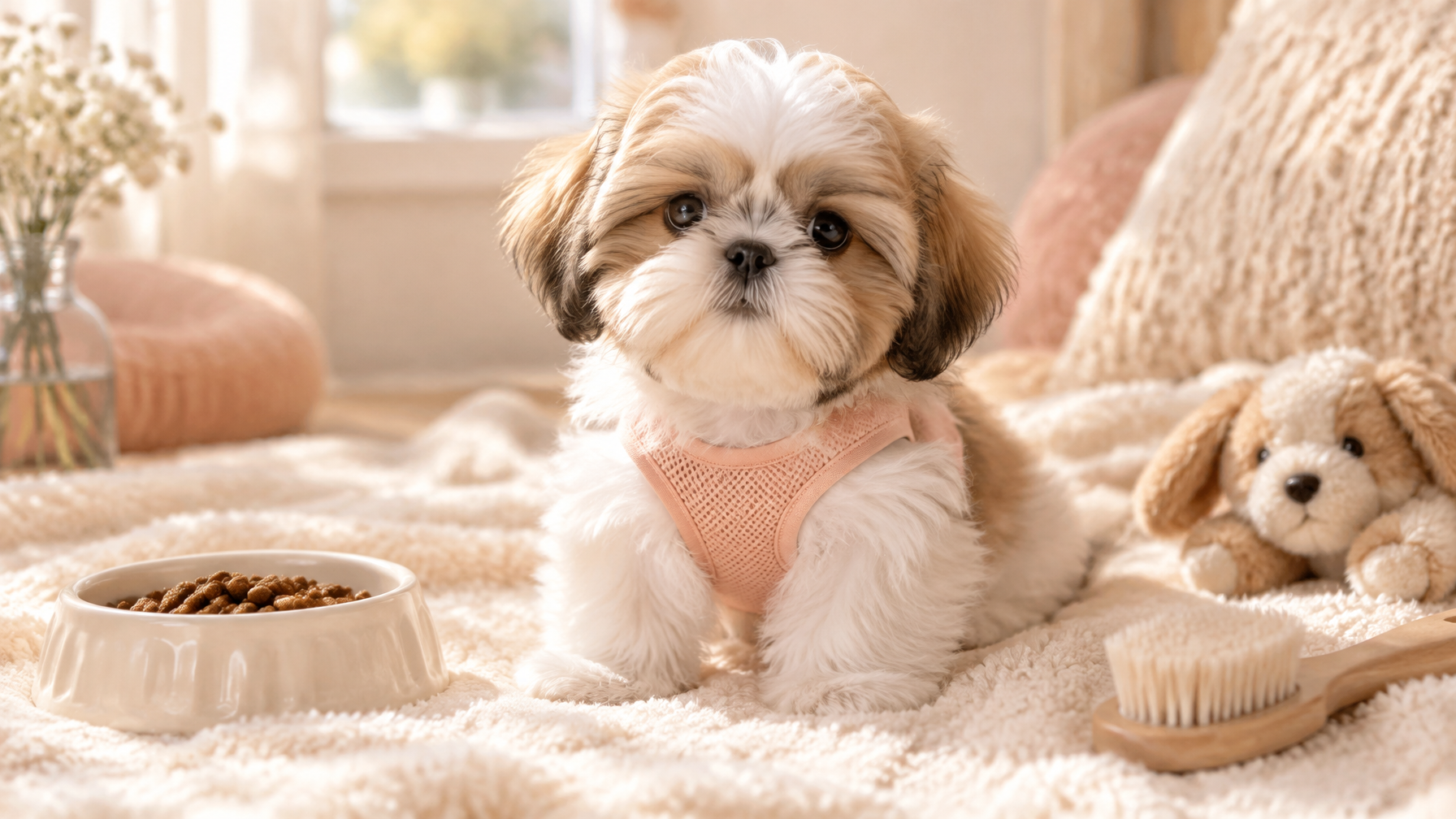
Before a Shih Tzu puppy comes home, get small-breed puppy food, a lightweight harness, a crate or pen, a soft brush and comb, and chew toys, and puppy-proof your home. In the first week, book a vet visit, feed three to four small meals a day to help prevent low blood sugar, and start gentle handling and face wiping. Keep up the vaccine series every 2–4 weeks until about 16 weeks, and use the first three months for safe, positive socialization.
- Small-breed puppy food
- Harness, not a collar, for walks
- Vet visit in the first week
- 3–4 small meals a day
- Vaccines every 2–4 weeks to ~16 weeks
- Socialize in the first 3 months
A Shih Tzu puppy is tiny, curious and fragile in ways bigger breeds aren’t. Low blood sugar, heat, a flat face and a coat that will need daily care all shape what you buy and what you do in the first weeks.
This guide covers what to have ready before day one, how to set up the first week, the vaccine timeline, and the breed-specific things to watch for.
01
What do you need before bringing a Shih Tzu puppy home?
The essentials are small-breed puppy food, shallow bowls, a lightweight harness and leash, a crate or playpen, a bed, a soft brush and comb, puppy-safe chew toys, and an ID tag.
| Item | Why it matters for a Shih Tzu puppy |
|---|---|
| Small-breed puppy food | Small bites for a small mouth. Start with what the breeder or shelter fed, then switch gradually if you change. |
| Shallow food and water bowls | Easier for a short, flat muzzle to reach into. |
| Lightweight mesh harness and leash | A harness keeps pressure off the neck and airway on walks, which matters for flat-faced breeds. |
| Soft collar with ID tag | For identification. Use the harness, not the collar, for walks. |
| Crate or playpen | A safe space for naps and for times you can’t supervise. |
| Small, washable bed | Puppies have accidents; washable saves time. |
| Soft bristle brush and metal comb | Start gentle brushing early so grooming becomes normal. |
| Soft cloths or dog eye wipes | Daily face wiping helps manage tear staining from the start. |
| Puppy toothbrush and dog toothpaste | Shih Tzus are prone to dental disease, so build the habit early. |
| Small, puppy-safe chew toys | Sized for a small mouth; teething puppies need something to chew. |
| Enzyme cleaner | Removes the smell from potty accidents so they don’t repeat in the same spot. |
Why a harness for walks?PetMD explains that a collar adds strain to the already compromised airways of flat-faced breeds, and recommends a harness instead, ideally a breathable mesh one to reduce the risk of overheating. It also advises against head harnesses for flat-faced dogs because of their prominent eyes.
02
How do you puppy-proof your home for a Shih Tzu?
Get down to puppy height and remove anything chewable, swallowable or toxic. Block stairs and drops, keep the puppy cool, and store foods that are dangerous to dogs out of reach.
- Cords and cables: tuck them away or cover them. Teething puppies chew anything.
- Small objects: socks, hair ties, coins and toy parts are choking and blockage risks for a tiny dog.
- Stairs and furniture: use baby gates. Jumps that are nothing for a bigger dog can hurt a small puppy.
- Toxic foods: the ASPCA lists foods to keep away from pets, including chocolate, grapes and raisins, onions and garlic, and xylitol (a sweetener in some gums and baked goods).
- Household chemicals and medicines: store them in closed cabinets.
- Heat: keep your puppy out of hot rooms, cars and direct sun. Flat-faced dogs are at higher risk of overheating.
03
What should the first week with a Shih Tzu puppy look like?
Keep it calm and routine-based: a vet visit within the first few days, three to four small meals at set times, frequent potty breaks, plenty of sleep, and short daily handling sessions.
- Book a vet visit for the first few days. Bring any vaccine and deworming records from the breeder or shelter.
- Feed three to four small meals a day at regular times. PetMD notes Shih Tzu puppies need frequent meals to reduce the risk of low blood sugar. See our Shih Tzu feeding guide for amounts and when to switch to adult food.
- Take your puppy out often: after waking, after meals, after play, and before bed. Praise and reward outdoor potties.
- Let them sleep. Puppies sleep a lot. A quiet crate or pen helps them rest.
- Start handling daily. Gently touch paws, ears, mouth and face for a few seconds, with treats. This makes grooming, nail trims and tooth brushing far easier later.
- Wipe the face daily with a soft, damp cloth, wiping away from the eyes.
- Keep visitors and outings low-key at first, then build up as your puppy settles.
04
What vaccines does a Shih Tzu puppy need, and when?
The AAHA guidelines recommend at least three doses of a combination core vaccine between 6 and 16 weeks of age, given 2–4 weeks apart, with rabies as required by law. Your vet will set the exact schedule.
| Vaccine | Puppy schedule (AAHA 2022) | Next dose |
|---|---|---|
| Core combination (distemper, adenovirus, parvovirus, ± parainfluenza) | At least 3 doses between 6 and 16 weeks, 2–4 weeks apart | One dose within 1 year of the last puppy dose, then every 3 years |
| Rabies | As required by law | As required by law |
| Leptospirosis (if your vet recommends it) | Two doses 2–4 weeks apart, starting at 12 weeks | Within 1 year, then annually |
Other vaccines depend on where you live and your puppy’s lifestyle. Ask your vet which ones apply, and keep a copy of every vaccine record.
That coat will need daily care
Brushing, bathing, eyes and nails: start the grooming habits early with our complete routine.
Read the puppy grooming section06
What health issues should you watch for in a Shih Tzu puppy?
The big three are low blood sugar, overheating and eye problems. Each is linked to the breed’s small size or flat face.
Low blood sugar (hypoglycemia)
PetMD notes Shih Tzu puppies are at risk of low blood sugar and need frequent meals.
Call your vet right awayIf your puppy seems weak, wobbly, trembling or unusually sleepy, especially after missing a meal. Low blood sugar in a small puppy can become an emergency quickly.
Overheating
Flat-faced breeds don’t cool down efficiently. Keep play sessions short in warm weather, always provide water and shade, and never leave a puppy in a car.
Eyes and tear stains
Large, prominent eyes need daily attention. Wipe the face daily, keep hair away from the eyes, and see your vet for redness, discharge, squinting or pawing at the eye. Our guide to Shih Tzu tear stains explains what’s normal and what isn’t.
The coat change
The AKC notes that many Shih Tzu coats change around 10 to 12 months old, and matting often gets worse during this stretch. Daily brushing habits started now pay off then.
As your puppy grows, see our full guide to health problems to watch for in adult Shih Tzus.
FAQ
Shih Tzu puppy FAQs
What do I need to buy for a Shih Tzu puppy?
Small-breed puppy food, shallow bowls, a lightweight mesh harness and leash, a collar with an ID tag, a crate or playpen, a washable bed, a soft brush and metal comb, soft cloths for face wiping, a puppy toothbrush and dog toothpaste, small chew toys, and an enzyme cleaner for accidents.
How often should a Shih Tzu puppy eat?
Three to four small meals a day. PetMD notes Shih Tzu puppies need frequent meals to reduce the risk of low blood sugar. Switch to two meals a day of adult food gradually, around 1 year old.
When should a Shih Tzu puppy get vaccinated?
AAHA’s guidelines recommend at least three doses of a combination core vaccine between 6 and 16 weeks of age, 2–4 weeks apart, with rabies as required by law. Your vet will set the exact schedule.
Should a Shih Tzu puppy wear a collar or a harness?
Use a harness for walks. PetMD explains that collars add strain to the airways of flat-faced breeds. A light collar with an ID tag is still useful for identification.
When can my Shih Tzu puppy start socializing?
Right away, with care. AVSAB says the first three months are the most important socialization period, and puppy classes can start as early as 7–8 weeks, at least 7 days after the first set of vaccines.
When should I start grooming my Shih Tzu puppy?
From the first week. Short, gentle brushing sessions, daily face wiping and handling the paws, ears and mouth help your puppy accept grooming before the adult coat comes in.
Sources
- 2022 AAHA Canine Vaccination Guidelines: Core and Noncore Vaccines (AAHA)
- Position Statement on Puppy Socialization (AVSAB)
- Shih Tzu Dog Breed: Health, Care and Lifestyle (PetMD)
- Why Flat-Faced Breeds Need Harnesses Instead of Collars (PetMD)
- People Foods to Avoid Feeding Your Pets (ASPCA Animal Poison Control)
- Shih Tzu Facts (American Kennel Club)
Update log
- October 10, 2026: Published. Vaccine timing, socialization guidance and breed health notes checked against the sources above.
This is general information, not veterinary advice. Consult your vet before making changes to your dog’s diet or care.
05
When and how should you socialize a Shih Tzu puppy?
Start right away. The American Veterinary Society of Animal Behavior (AVSAB) calls the first three months the most important socialization period, and says puppy classes can start as early as 7–8 weeks, at least 7 days after the first set of vaccines.
AVSAB’s position statement warns that behavioral problems, not infectious diseases, are the number one cause of death for dogs under three years old, which is why it recommends not waiting until vaccines are complete to start socializing.