
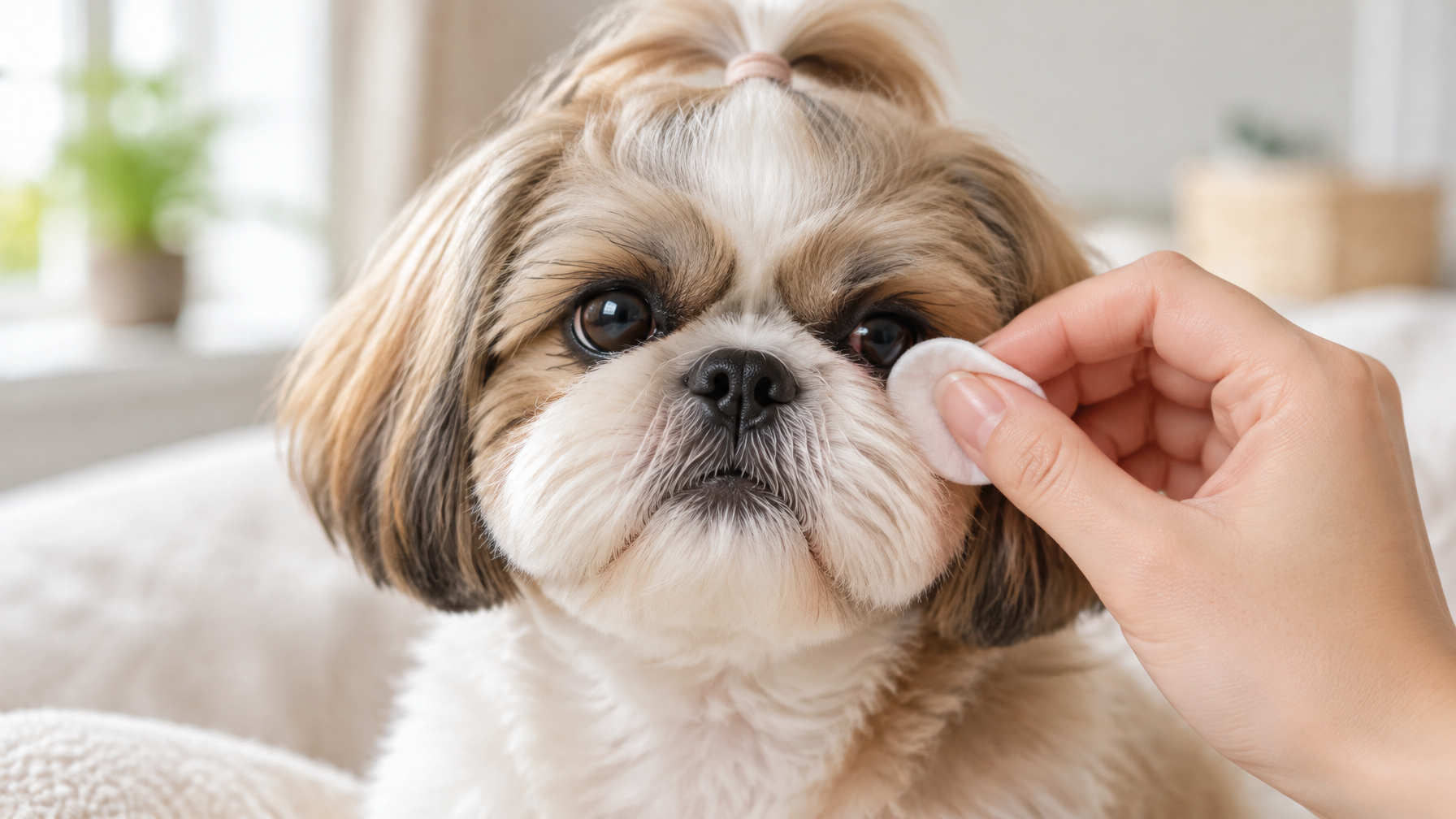
Shih Tzu eye care comes down to three habits: wipe the eyes daily with a fresh damp cotton pad or vet-approved wipe, keep hair off the eyes with a trim or topknot, and see a vet the same day for squinting, a cloudy or red eye, or thick yellow-green discharge. Their big, exposed eyes injure easily and may not show pain the usual way, so small changes matter. An eye that bulges out of its socket is an emergency.
- Wipe daily, a fresh pad for each eye
- Keep hair trimmed or tied up
- Squinting or cloudiness = vet today
- No human or leftover eye drops
- Walk on a harness, not a collar
A Shih Tzu’s big, round eyes are a big part of the breed’s charm. They’re also one of its weak spots. The eyes sit in shallow sockets, are partly exposed, and have hair growing right next to them, so they dry out, get scratched and pick up irritation more easily than most dogs’ eyes.
This guide covers the daily routine that keeps a Shih Tzu’s eyes comfortable, how to tell normal eye gunk from a warning sign, and what to do in an emergency. If brown staining under the eyes is your main concern, see our separate guide to Shih Tzu tear stains.
01
Why do Shih Tzu eyes need extra care?
Shih Tzus are flat-faced (brachycephalic), so their eyes sit in shallow sockets, bulge forward and are more exposed. Many don’t blink fully, hair and facial folds can rub the eye, and flat-faced dogs may not show the usual signs of eye pain.
Vets group these traits under brachycephalic ocular syndrome. A 2026 review in Today’s Veterinary Practice, by veterinary ophthalmologist Dr. Caryn Plummer, describes how they add up in breeds like the Shih Tzu:
- Incomplete blinking. In one study cited by the review, 82% of Shih Tzus had lagophthalmos, meaning the lids don’t fully close when the dog blinks. The uncovered part of the eye can dry out and become irritated.
- Exposed, prominent eyes. Shallow sockets and wide eyelid openings leave more of the eye surface exposed, and make injuries more likely.
- Hair and folds touching the eye. Hair from the nose fold and inner corner of the eye can rub the surface. The review lists the Shih Tzu among the breeds most often affected by distichiasis, extra eyelashes that grow toward the eye.
- Pain may be hidden. The Kennel Club notes that flat-faced dogs have reduced corneal sensitivity, so they may not show the usual signs of an ulcer, which can deepen unnoticed.
Shih Tzus are also prone to inherited eye conditions such as dry eye, glaucoma and cataracts. Our guide to common Shih Tzu health issues covers those in the context of the breed’s overall health.
02
How do you clean a Shih Tzu’s eyes?
Dampen a clean cotton pad or soft cloth with sterile saline or a vet-recommended eye wipe, and gently wipe from the inner corner along the lid toward the ear. Use a fresh pad for each eye, then dry the hair around the eye. Do it daily.
- Choose a gentle solution. The AKC suggests vet-recommended eye wipes or sterile saline. Boiled water, cooled completely, also works.
- Soften any crust first. Hold the damp pad over dried gunk for a few seconds instead of picking or scraping it off.
- Wipe away from the eye. Wipe along the lid from the inner corner toward the ear. Don’t pull the eyelids open.
- Use a fresh pad for each eye, so you don’t carry gunk or infection from one eye to the other.
- Dry the hair and folds. Damp hair under the eyes holds moisture against the skin. The TVP review recommends cleaning and drying the hair around the eyes and the folds below the face as a routine.
- Look while you clean. This is your daily eye check. Compare both eyes for redness, cloudiness, squinting or a change in discharge.
Keep these away from the eyesThe AKC warns against soap, essential oils, homemade remedies, alcohol-based products, hydrogen peroxide, rough cloths and cotton swabs near the eyes. Swabs can poke the eye if your dog moves suddenly.
Make it part of the brush-outDoing the eye wipe at the same time as the daily brushing is the easiest way not to skip it. Our Shih Tzu grooming guide covers the full face routine.
Want the kit? See our best eye care products for Shih Tzus: gentle wipes, an eye rinse, safety scissors and topknot bands.
03
Should you trim the hair around a Shih Tzu’s eyes?
Yes. Hair that pokes into the eyes causes irritation, extra tearing and staining. Keep it short with blunt-nose scissors, ask your groomer to trim it between full haircuts, or tie longer hair up in a topknot.
- Trim with blunt-nose scissors. The AKC recommends them for the hair around the eyes, because a sudden head movement near sharp points can injure the eye. Hold the scissors parallel to the face, never pointed at the eye.
- Or tie it up. Long head hair can be pulled up into a topknot with a small, soft band. Redo it every day or two so it doesn’t pull or mat.
- Not confident? Use your groomer. Many groomers do a quick face or “eye trim” between full haircuts. This is a good option if your dog won’t keep still.
- Pick a face-friendly cut. Shorter face styles keep hair out of the eyes with less daily work. Our guide to Shih Tzu haircut styles compares the options.
Eyes are one part of the daily routine.
Brushing, bathing, ears, nails and face: the full Shih Tzu grooming routine in one place.
Read the Shih Tzu grooming guide04
What eye discharge is normal for a Shih Tzu, and what isn’t?
A small amount of clear tearing or dark crust in the inner corner is usually normal. Thick yellow-green discharge, squinting, a red or cloudy eye, or pawing at the face is not, and needs a vet.
| What you notice | What it can mean | What to do |
|---|---|---|
| A little clear tearing or dark crust in the corner, both eyes | Usually normal for the breed | Wipe daily and keep an eye on it |
| Brown or red staining below the eyes | Tear staining, often cosmetic | See our tear stain guide; vet if it’s new or sudden |
| Thick yellow-green discharge | Infection or dry eye (KCS) | See your vet |
| Squinting, keeping one eye shut, pawing or rubbing | Pain, possibly a corneal ulcer or something in the eye | See your vet the same day |
| Cloudy, blue-white or hazy eye | Ulcer, glaucoma or cataract | See your vet promptly |
| Red, swollen eye or sudden heavy watering | Irritation, injury, lash or eyelid problem | See your vet |
| Brown or black film spreading over the eye | Pigment on the cornea from long-term irritation | Book a vet eye exam |
| Eye bulging out of the socket | Proptosis | Emergency vet now (see below) |
Dry eye is worth knowing about. Cornell University lists the Shih Tzu among the breeds more prone to keratoconjunctivitis sicca (KCS), where the eye doesn’t make enough of the watery part of tears. Thick yellow-green discharge is a classic sign. Vets diagnose it with a quick Schirmer tear test, and it usually needs lifelong eye drops. Left untreated, it can lead to permanent damage or vision loss.
Don’t wait for obvious painThe Kennel Club says corneal ulcers in flat-faced dogs are “always serious” and can progress quickly, and these dogs may not show typical pain signs. If one eye looks different from the other, have it checked.
05
What should you do if your Shih Tzu’s eye pops out?
Go to an emergency vet immediately. On the way, keep the eye moist with a clean pad soaked in sterile saline or clean water, stop your dog pawing at it, and never try to push it back in yourself.
Proptosis is when the eyeball is pushed forward out of the socket. Animal Trust Vets names the Shih Tzu among the flat-faced breeds at risk, because shallow sockets mean even minor trauma can cause it. An eye clinic notes it’s often linked to a fight or a big dog-small dog scuffle, overly rough restraint, or choke injuries.
- Stay calm and keep your dog still. Hold your dog gently, without pressure on the head or neck.
- Cover the eye with moisture. Use a clean pad or cloth soaked in sterile saline or clean water. Keep it wet on the way.
- Stop pawing. Hold the front paws gently, or use a cone if you have one.
- Don’t push the eye back. Replacing it is done by a vet under anesthesia.
- Call ahead so the emergency vet is ready for you.
Speed matters. Vision outcomes vary a lot, but the sooner the eye is treated, the better the chance of saving it. Any other eye injury, such as a scratch, a chemical in the eye or a suddenly cloudy eye, also needs a same-day vet visit.
06
Can you use eye drops on a Shih Tzu?
Only drops your vet recommends. Don’t use human redness-relief drops like Visine, and never reuse leftover drops from an earlier problem, especially steroid drops, which can make an ulcer worse.
- No human redness drops. Pet Poison Helpline warns that Visine isn’t approved for pets. Its active ingredient, tetrahydrozoline, can irritate a dog’s eyes and is dangerous if swallowed.
- No leftover steroid drops. VCA notes that steroids shouldn’t go into an eye until a vet has confirmed there’s no ulcer, using a dye test. An old bottle from a past problem can harm an injured eye.
- Lubricating drops, with your vet’s guidance. For dogs that don’t blink fully or have dry eye, vets often recommend artificial tears or lubricating gels. The TVP review notes gels or ointments last longer, for example overnight. Ask your vet which product and how often.
- Finish prescribed treatment. VCA advises never stopping eye medication without your vet’s approval, even if the eye looks better.
07
How can you prevent eye injuries in a Shih Tzu?
Walk on a harness instead of a collar, supervise play with bigger dogs, keep shampoo away from the face, keep hair off the eyes, and book a yearly eye exam with a tear test.
- Use a harness, not a collar. In a 2006 study of 26 dogs in the Journal of the American Animal Hospital Association, pressure inside the eye rose significantly when dogs pulled against a collar, but not with a harness. The authors advised a harness for dogs whose eyes could be harmed by that pressure. Shih Tzus also need a harness for their airway. See our best harness for Shih Tzus.
- Supervise play with big dogs. Rough play and scuffles are a common cause of eye injuries in small, flat-faced dogs.
- Keep shampoo out of the eyes. VCA lists shampoo among the irritants that can cause chemical burns to the cornea. Wash the face last with a damp cloth.
- Get a yearly eye exam. The TVP review recommends annual eye exams with a Schirmer tear test for flat-faced breeds, so dry eye is caught early.
- Buying a puppy? Ask the breeder whether the parents had eye screening. The Kennel Club runs eye screening schemes to reduce inherited eye disease. Our new Shih Tzu puppy checklist has more questions to ask.
Ears need the same weekly attention. See our Shih Tzu ear care guide.
08
Shih Tzu eye care FAQs
How often should I clean my Shih Tzu’s eyes?
Once a day is a good routine for most Shih Tzus, and more often if your dog tears heavily. Use a fresh damp cotton pad for each eye, wipe from the inner corner outward, and dry the hair afterward.
What can I use to clean my Shih Tzu’s eyes?
Sterile saline or vet-recommended dog eye wipes, on a clean cotton pad or soft cloth. Cooled boiled water also works. Avoid soap, essential oils, hydrogen peroxide, alcohol-based products and cotton swabs near the eyes.
Why does my Shih Tzu have green eye discharge?
Thick yellow-green discharge can be a sign of an eye infection or dry eye (KCS), which is more common in Shih Tzus. It needs a vet visit. Dry eye is diagnosed with a quick tear test and usually needs ongoing eye drops.
Why is my Shih Tzu squinting one eye?
Squinting usually means eye pain, and in a Shih Tzu a common cause is a corneal ulcer or something caught in the eye. Flat-faced dogs may not show much pain, and ulcers can worsen quickly, so see your vet the same day.
Can I use human eye drops on my Shih Tzu?
No, not without your vet’s advice. Redness-relief drops such as Visine aren’t approved for pets and can irritate a dog’s eyes. Never reuse leftover medicated drops either. Ask your vet for a dog-safe lubricant if your Shih Tzu’s eyes are dry.
Sources
- Understanding and Addressing Brachycephalic Ocular Syndrome (Today’s Veterinary Practice, Caryn E. Plummer, DVM, DACVO)
- Keratoconjunctivitis Sicca (KCS) in Dogs (Cornell University Riney Canine Health Center)
- Corneal Ulcers in Dogs (VCA Animal Hospitals)
- Eye Problems in Brachycephalic Dogs (The Kennel Club)
- How to Clean Your Dog’s Eyes (American Kennel Club)
- Eye Prolapse (Animal Trust Vets)
- Proptosis in Dogs (Indy Animal Eye Clinic)
- Visine Toxicity in Dogs (Pet Poison Helpline)
- Effects of Neck Pressure by a Collar or Harness on Intraocular Pressure in Dogs (Journal of the American Animal Hospital Association, 2006)
Update log
- : Published. Eye care advice checked against the veterinary sources above.
This is general information, not veterinary advice. Consult your vet before making changes to your dog’s diet or care.