
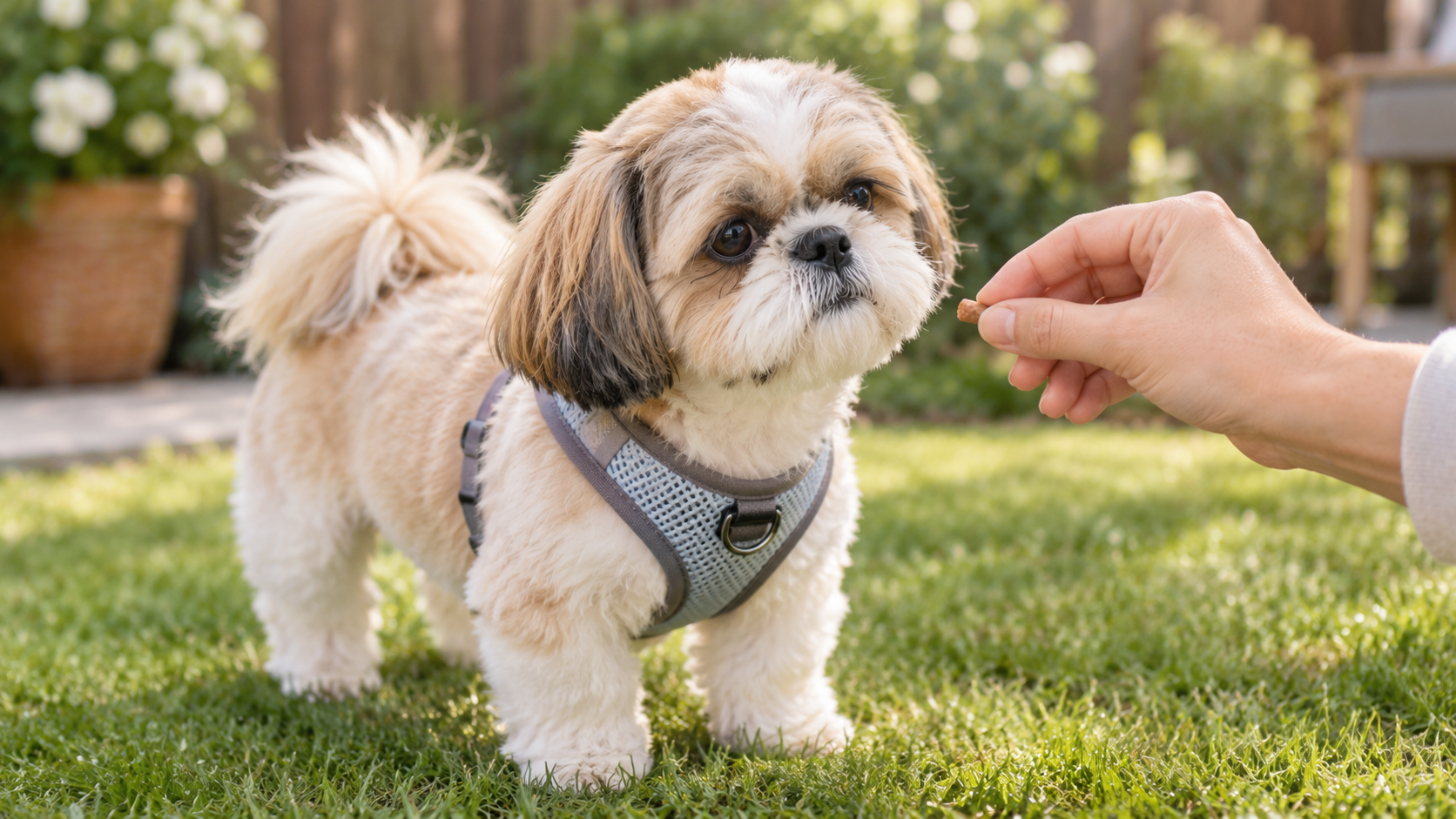
To potty train a Shih Tzu, take your puppy to the same spot on a fixed schedule: after waking, within 10–15 minutes of eating or playing, after naps and before bed, and every 1–2 hours in between for young puppies. Reward immediately with praise and a tiny treat, use a right-sized crate and close supervision, clean accidents with an enzymatic cleaner, and never punish. Most owners succeed within 1–2 months, though small breeds often need extra patience.
- Same spot, same schedule, every day
- Reward within seconds of finishing
- Crate just big enough to stand and turn
- Enzymatic cleaner for every accident
- No punishment, ever
Shih Tzus have a reputation for being tricky to house train, and many owners find that’s fair. A tiny puppy has a tiny bladder, an accident behind the sofa is easy to miss, and a dog bred to be a companion can be more interested in you than in the lawn.
The good news: the method that works is simple, and it’s the same one veterinary behaviorists recommend. This guide covers a realistic potty schedule by age, crate and pad choices, how to handle accidents, and a few Shih Tzu-specific problems most training guides don’t mention.
01
Are Shih Tzus hard to potty train?
They can take longer than some breeds, but they’re very trainable with consistency. The AKC notes accident complaints are common among owners of toy breeds, and a long-time Shih Tzu breeder quoted by the AKC describes the puppies as “challenging to train” but responsive to routine and rewards.
- Small bladder, frequent trips. The AKC’s rule of thumb is that puppies can hold it for about one hour per month of age. A tiny Shih Tzu puppy simply needs to go often.
- Accidents are easy to miss. A small puddle in a quiet corner goes unnoticed, so the puppy never learns that spot is wrong, and the smell draws it back.
- They love ritual. “Shih Tzu do what they want but they respond well to ritual,” breeder Nancy Broz told the AKC. The same routine every day is what works.
- Consistency is often the real gap. A study led by Christine Arhant at the University of Veterinary Medicine Vienna found owners of small dogs tended to be less consistent in how they interacted with their dogs, which affected obedience. It didn’t study toilet training specifically, but consistency is the core of potty training.
How long it takes: Dr. Kelly Ballantyne, a board-certified veterinary behaviorist, writes in Today’s Veterinary Practice that most owners can house train within 1–2 months. The AKC says some puppies get reliable within days and others take several months. Expect a wobble around 7–8 months, when the breeder quoted by the AKC says Shih Tzu adolescents can turn stubborn and “forget” earlier training.
02
What’s a good potty schedule for a Shih Tzu puppy?
Take your puppy out first thing in the morning, last thing at night, after every nap, within 10–15 minutes of eating, drinking or playing, after crate time, and every 1–2 hours while awake for young puppies. Stretch the gaps gradually as your puppy gets older.
| Puppy age | Roughly how long it can hold it* | What to do |
|---|---|---|
| 8–10 weeks | About 2 hours | Out every 1–2 hours awake, plus after every meal, nap and play |
| 3 months | About 3 hours | Every 2 hours awake; one night trip is normal |
| 4–5 months | About 4–5 hours | Every 2–3 hours; many puppies start sleeping through |
| 6 months+ | About 6 hours, up to an adult limit around 9–12 months | Regular breaks; keep the morning, after-meal and bedtime trips |
*Based on the AKC’s “one hour per month of age” rule of thumb. It’s a ceiling, not a target: individual puppies vary, and toy breeds often need to go sooner.
- The big moments: on waking, after meals and drinks, after play and chewing, after naps and crate time, and before bed. Today’s Veterinary Practice recommends going out within 10–15 minutes of meals and play.
- Shih Tzu puppies eat often. Small, frequent meals help prevent low blood sugar in toy puppies, so plan a potty trip after each one. Our Shih Tzu feeding guide covers meals per day by age.
- Write it down for the first week. Note when your puppy eats, sleeps and goes. Patterns appear fast, and you can time trips before accidents happen.
03
How do you potty train a Shih Tzu, step by step?
Pick one potty spot, take your puppy there on schedule, wait quietly, reward the moment it finishes, and supervise or confine the rest of the time. Prevention plus instant rewards is the whole method.
- Choose one spot. Use the same patch of grass or the same pad location every time. Familiar smells prompt the puppy to go.
- Carry or walk your puppy straight there on schedule, on a lightweight harness and leash so it doesn’t wander off to play.
- Stay quiet and boring. Give it a few minutes. If nothing happens, go back inside, supervise closely and try again in 10–15 minutes.
- Reward immediately. The AKC says to praise and give a small, high-value treat right after your puppy finishes in the correct spot. Seconds matter: rewarding back indoors teaches nothing.
- Add a cue word (like “go potty”) just as your puppy starts going. Over time it learns to go on cue, which helps on rainy nights.
- Supervise or confine. Today’s Veterinary Practice recommends close supervision, and confinement when you can’t watch. A playpen or crate stops unnoticed accidents.
- Use a right-sized crate. The AKC says your puppy should be able to stand, turn and lie down comfortably, but not have room to potty in one corner and sleep in another. Use a divider as your Shih Tzu grows.
- Clean every accident with an enzymatic cleaner, as both the AKC and Today’s Veterinary Practice advise, so the smell doesn’t draw your puppy back.
Use tiny treatsA 9–16 lb dog doesn’t need much. Use pea-sized pieces, or part of the daily food allowance, so potty rewards don’t lead to weight gain. Treats should stay under 10% of daily calories.
Just bringing a Shih Tzu puppy home?
What to buy, the first week, vaccines and socialization, all in one checklist.
Read the new puppy checklist04
Should you use pee pads for a Shih Tzu?
Only if outdoor training isn’t practical. Pads can help if you’re out for long stretches, live in a high-rise, or have harsh weather, but they can slow down outdoor training because they teach two acceptable places. Pick one main option and stick with it.
- The trade-off. AKC expert Dr. Burch warns that with pads “you’re reinforcing two different options for the puppy,” which can slow the move outdoors.
- When pads make sense. The AKC notes pads or indoor potty boxes can suit owners who can’t get home during the day, or small dogs in severe weather. Some trainers use them like a litter box for toy breeds.
- If you use pads, keep them in one fixed spot, away from the bed and food bowls, and treat a pad like the outdoor spot: same schedule, same rewards.
- Moving from pads to outdoors: gradually move the pad toward the door, then take a used pad outside to the new spot so it smells familiar.
05
What should you do when your Shih Tzu has an accident?
If you catch it in the act, calmly interrupt and take your puppy to the potty spot. If you find it later, just clean it up. Never punish, rub its nose in it or shout. Punishment doesn’t teach where to go and can make a puppy afraid to go in front of you.
- Don’t punish. Today’s Veterinary Practice warns punishment “can cause fear, anxiety, and aggression” and doesn’t teach the dog where to eliminate. The AKC says punishing accidents is less effective than rewarding the right behavior and preventing mistakes.
- A fearful puppy hides. If going in front of you led to trouble, a puppy may sneak behind furniture instead. That makes training harder, not easier.
- Clean with an enzymatic cleaner. Regular cleaners can leave a smell your dog still detects.
- Treat an accident as information. It usually means the gap between trips was too long or supervision slipped. Shorten the schedule for a few days.
06
Are there Shih Tzu-specific potty training tips?
Yes. Keep the hair around the rear trimmed so it stays clean, dry your Shih Tzu’s coat after wet potty trips, plan breaks around the heat, and always use a harness, not a collar, for potty walks.
- Keep a sanitary trim. Long hair around the rear can get soiled, which is unpleasant for your dog and can stop it from wanting to go. The UKC breed standard notes even show Shih Tzus are trimmed at the rear for neatness. Ask your groomer, or see our guide to Shih Tzu haircut styles.
- Rain and wet grass. A long-coated toy dog gets soaked fast and may refuse to go. A covered spot, or a short cut, helps. Towel-dry the belly and legs afterward; damp coat mats, as covered in our Shih Tzu grooming guide.
- Hot days. Shih Tzus are flat-faced and overheat easily. Keep summer potty trips short and in shade, and avoid hot pavement. See our Shih Tzu hot weather guide.
- Harness, not collar. A collar presses on a flat-faced dog’s airway. See our best harness for Shih Tzus.
- Night trips. Keep them quiet, dim and quick: out, potty, reward, back to bed. No play, or your puppy will learn that 3 a.m. is party time.
07
When is a potty problem actually a medical problem?
See your vet if your Shih Tzu suddenly starts having accidents after being reliably trained, goes much more often, strains, seems uncomfortable, has blood in the urine, or drinks far more than usual. Medical problems can look like “training failures.”
- Rule out medical causes first. Today’s Veterinary Practice notes anything that increases the urgency or frequency of elimination, or makes it painful, can cause house soiling. Vets typically start with a urine test.
- Older dogs can regress. The same source notes cognitive dysfunction (canine dementia) is common in senior dogs and can cause indoor accidents.
- Soiling is common. Today’s Veterinary Practice says house soiling is reported in about 20% of pet dogs, so you’re not alone, but it’s worth a vet check if it’s new.
Our guide to common Shih Tzu health issues covers the breed’s main health risks and when to see a vet.
08
Shih Tzu potty training FAQs
How long does it take to potty train a Shih Tzu?
Most owners can house train a dog within 1–2 months, according to a veterinary behaviorist writing in Today’s Veterinary Practice, though some puppies take several months. Toy breeds like the Shih Tzu often need extra patience. Keep supervising until you’ve had about 8 weeks with no indoor accidents.
Are Shih Tzus hard to potty train?
They can be. Toy breeds have small bladders and accidents are easy to miss, and the AKC notes accident complaints are common with toy breeds. But Shih Tzus respond well to routine and rewards, so a consistent schedule usually works.
How often should a Shih Tzu puppy go potty?
Young puppies need to go out every 1–2 hours while awake, plus after waking, eating, drinking, playing and napping, and before bed. The AKC’s rule of thumb is that a puppy can hold it for about one hour per month of age, up to an adult limit.
Should I use pee pads for my Shih Tzu?
Only if outdoor training isn’t practical, for example if you’re away for long stretches or live in a high-rise. Pads can slow outdoor training because they teach two acceptable places, so choose one main option and stay consistent.
Why does my potty-trained Shih Tzu keep having accidents?
Common reasons include a schedule that slipped, a missed accident spot that still smells, adolescence around 7–8 months, or a medical problem such as a urinary issue. If accidents start suddenly or come with straining or frequent urination, see your vet.
Sources
- How to Potty Train a Puppy (American Kennel Club)
- How to Train a Shih Tzu Puppy: Training Timeline (American Kennel Club)
- Canine House Soiling: Back to Basics (Today’s Veterinary Practice, Kelly C. Ballantyne, DVM, DACVB)
- Why Small Dogs Behave Differently Than Large Dogs (American Kennel Club, on the Arhant study)
- Shih Tzu Breed Standard (United Kennel Club)
Update log
- : Published. Training advice checked against the sources above.
This is general information, not veterinary advice. Consult your vet before making changes to your dog’s diet or care.