
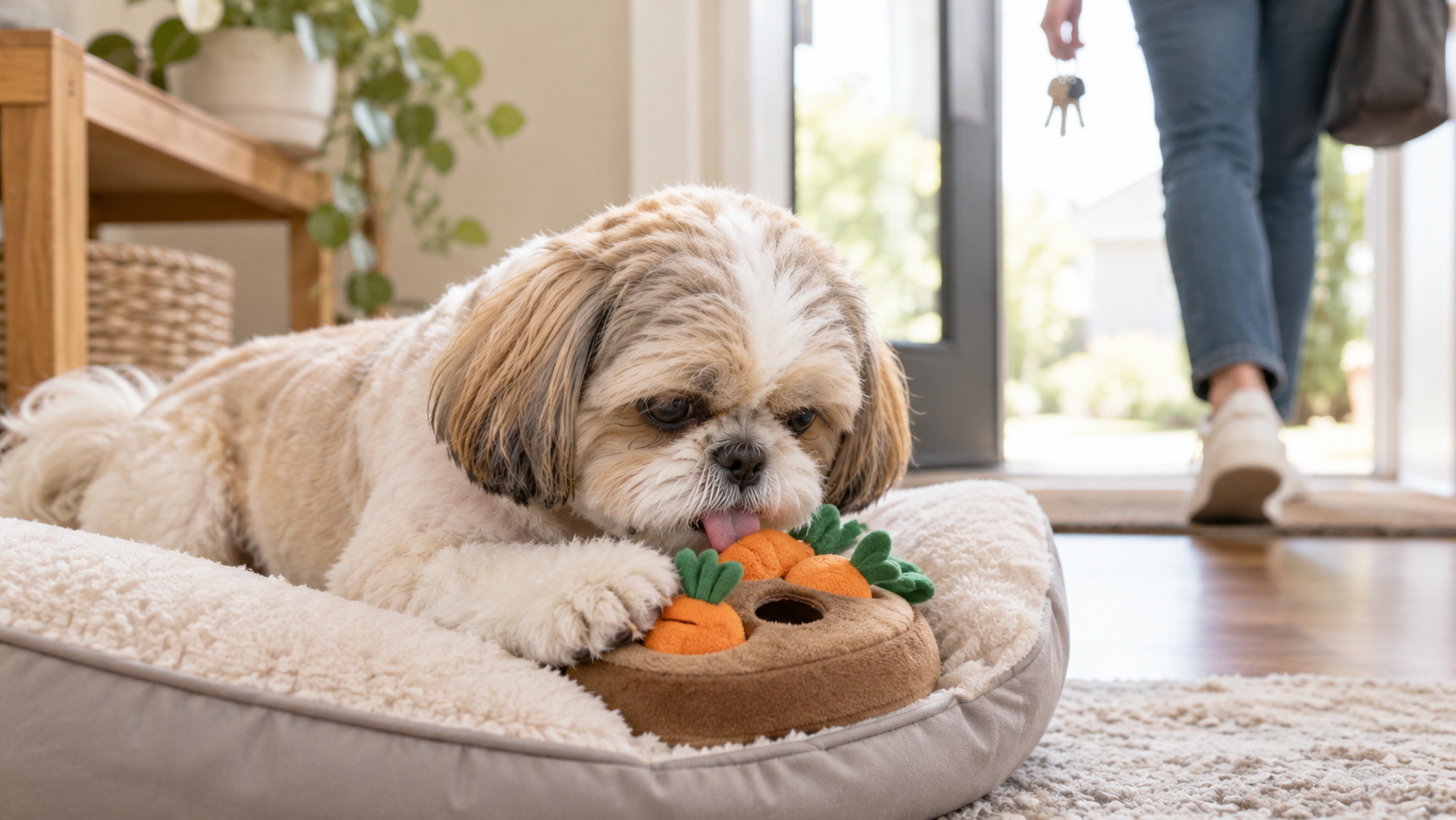
Shih Tzus were bred as lap companions, and some become genuinely distressed when left alone. Real separation anxiety shows up only when you’re gone: barking or howling, chewing doors, accidents, drooling or frantic escape attempts, often within minutes of you leaving. Rule out medical causes first, film your dog while you’re out, then use a slow desensitization plan that starts with absences of just a few seconds. Never punish. For moderate or severe cases, see your vet: two medications are FDA-approved for canine separation anxiety.
- Signs happen only when you’re away
- Vet check first, then film it
- Start with 1–2 second absences
- Avoid full-length absences while training
- No punishment, no shock collars
Coming home to a chewed door frame, a puddle by the front door and a neighbor’s complaint about barking is stressful. With a Shih Tzu, it’s easy to assume the dog is “spoiled” or “naughty.” But true separation anxiety is a panic response, not bad behavior, and treating it as disobedience usually makes it worse.
Most articles on this topic either sell a calming supplement or list the same few generic tips. This guide is different: it shows you how to tell separation anxiety apart from boredom or house-training gaps, gives you the step-by-step plan behavior experts use, and explains when medication is worth discussing with your vet.
01
Are Shih Tzus prone to separation anxiety?
There’s no good data showing Shih Tzus get it more than other breeds. But they were bred purely as companions, many spend nearly all day with their owners, and that strong attachment is one recognized pattern behind separation problems. Life changes and long hours alone are bigger risk factors than breed.
It’s commonly claimed online that Shih Tzus are “prone” to separation anxiety, but we couldn’t find a study that measured it in the breed. Here’s what the veterinary literature does say:
- It’s common overall. In a review in Today’s Veterinary Practice, veterinary behaviorists Dr. Lisa Radosta and Dr. Ariel Fagen report that 14–50% of dogs seen by behavior specialists have separation-related problems, and 55% show signs before age 3.
- Three patterns. The same review describes dogs that are hyper-attached (often from puppyhood), dogs whose problem starts after a schedule change, a life change or aging, and dogs whose problem starts after a frightening experience.
- Known risk factors include long daily periods alone, changes in schedule or household, single-owner homes, rescue or shelter adoption, and lack of training.
- Common triggers, per the ASPCA: a change of owner or family, a sudden schedule change (such as going from having someone home all day to being alone for six or more hours), moving house, or losing a family member.
A Shih Tzu that follows you from room to room and sleeps on your lap isn’t automatically anxious. The question is how it copes when you’re not there.
02
What are the signs of separation anxiety in a Shih Tzu, and what else could it be?
The key sign is timing: problems happen only when your dog is alone, often within minutes of you leaving, and your dog may get anxious as you prepare to go. Barking, chewing or accidents that also happen while you’re home usually point to something else.
Signs the ASPCA lists include barking or howling, chewing or digging (often at doors and windows), escape attempts, pacing, urinating or defecating indoors, and distress such as pacing, panting or whining as you pick up keys or put on a coat.
| What you see | Separation anxiety if… | Probably something else if… |
|---|---|---|
| Accidents indoors | Only when alone | Also happen with you home: incomplete house training, a medical issue, or excitement urination |
| Chewing and destruction | Only when alone, aimed at doors and windows | Also when you’re home, and the dog seems relaxed: boredom or teething |
| Barking or howling | Starts soon after you leave and goes on | Also barks at noises when you’re home: alert barking (see our Shih Tzu barking guide) |
| Panting and pacing | Starts as you prepare to leave | Also on warm days or after activity: heat or breathing, which matters in a flat-faced breed |
| Drooling, trembling, not eating while alone | Only during absences | Also at other times: see your vet |
Film your dogSet up a phone or pet camera and record the first 30–60 minutes after you leave. Today’s Veterinary Practice notes many signs are “silent” by the time you get home. Video shows whether it’s panic, boredom or a single bark at the mailman, and it’s the most useful thing you can show your vet or a behaviorist.
Need a camera? See our best pet camera for Shih Tzus, including options that record without a subscription.
03
What should you rule out before treating separation anxiety?
See your vet first. Urinary problems, other illnesses, medications and pain can all cause accidents or restlessness. Then check for gaps in house training, boredom, noise fears and confinement stress, which can look similar.
- Medical causes. The ASPCA advises a vet visit before starting behavior work, because incontinence can come from urinary tract infections, age-related weakness, diabetes, kidney disease and other conditions. Some medications also cause frequent urination. Today’s Veterinary Practice suggests baseline blood and urine tests.
- House training. Toy breeds often take longer to house train fully. If accidents also happen while you’re home, start with our Shih Tzu potty training guide.
- Breathing and heat. Heavy panting in a Shih Tzu can be a sign of overheating or airway trouble, not just stress. If your dog pants heavily in a warm room, see our Shih Tzu hot weather guide and our guide to common Shih Tzu health issues.
- Noise fears. Today’s Veterinary Practice notes 30–60% of dogs with separation problems also fear storms or loud noises. If episodes match storms or fireworks, mention that to your vet.
- Confinement stress. Some dogs panic about being shut in a crate, not about being alone. Compare how your dog behaves crated vs loose in a safe room.
- Senior changes. A senior Shih Tzu that suddenly starts showing these signs needs a vet check, since aging is one of the triggers the review describes.
04
How can you help a mildly anxious Shih Tzu?
Give a long-lasting food toy each time you leave, keep departures and returns calm, give exercise and mental work before you go, and use background sound to mask outside noise. This is often enough for mild cases. Dogs too anxious to eat alone need the full training plan.
- A “leaving” food toy. The ASPCA suggests a stuffed puzzle toy that takes at least 20–30 minutes to finish, given only when you leave and picked up when you return. For a 9–16 lb dog, use part of the daily food allowance so it doesn’t add calories. See our best toys for Shih Tzus for small food puzzles.
- Calm goodbyes and hellos. The ASPCA advises a quick pat and goodbye, and waiting until your dog is relaxed before giving attention when you get home.
- Exercise first, sized for a Shih Tzu. The ASPCA suggests aerobic activity before you leave. A flat-faced toy dog doesn’t need a run: a 20–30 minute walk in the cool part of the day plus a sniffing game works better. Our Shih Tzu exercise guide has safe options.
- Background sound. Today’s Veterinary Practice suggests white noise or music to mask outside triggers like footsteps or doorbells.
- Practice independence at home. Reward your Shih Tzu for settling on its bed while you’re in another room, so being apart becomes normal.
Tire the brain, not just the legs.
Daily exercise by age, heat-safe walks and indoor sniffing games for flat-faced dogs.
Read the Shih Tzu exercise guide05
How do you train a Shih Tzu to be alone, step by step?
Use desensitization and counterconditioning: practice departure cues without leaving, then build absences from 1–2 seconds up, a few seconds at a time, always staying below the point where your dog gets anxious. Several short sessions a day for weeks is normal. A qualified behaviorist can guide moderate or severe cases.
This plan follows the ASPCA’s program for moderate to severe separation anxiety.
| Stage | What you do | Move on when |
|---|---|---|
| 1. Departure cues | Pick up keys, put on shoes or a coat, then sit back down. Repeat many times a day. | Your dog stays relaxed when it sees the cues |
| 2. Seconds away | Step out of the door for 1–2 seconds, then come back calmly | Relaxed at 1–2 seconds |
| 3. Short absences | Build to 5–10 seconds, then add a food toy as you leave | No stress signs |
| 4. Building time | Add only a few seconds per session, with a few minutes between absences | You reach about 40 minutes |
| 5. Bigger steps | Increase in 5-minute, then 15-minute steps | You reach about 90 minutes |
| 6. Longer absences | Try 4 hours, then build toward a full day | Your dog copes calmly |
- Watch for stress signs during sessions: the ASPCA lists dilated pupils, panting, yawning, drooling, trembling and pacing. If you see them, go back a step.
- Don’t rush. Today’s Veterinary Practice warns that pushing too fast can make dogs more sensitive to departures, not less.
- Avoid real absences while training. The ASPCA says your dog shouldn’t experience full-length absences during the program. Use a sitter, a family member, dog daycare or take your Shih Tzu with you. Small size makes this more realistic than it is for big dogs.
- Get qualified help. The ASPCA recommends a certified applied animal behaviorist (CAAB), a board-certified veterinary behaviorist (Dip ACVB) or a qualified certified trainer (CPDT) for moderate or severe cases.
Never punishThe ASPCA stresses that anxious behaviors “are distress responses” and punishment can make the problem much worse. Today’s Veterinary Practice advises against yelling, hitting and shock collars, which can increase anxiety.
06
Should you crate a Shih Tzu with separation anxiety?
Only if your dog is truly relaxed in the crate. For some dogs a crate is a safe den, but for others confinement makes panic worse. If your Shih Tzu pants heavily, drools, howls or tries to escape in the crate, use a safe room behind a baby gate instead.
- Watch the signs. The ASPCA says heavy panting, heavy drooling, frantic escape attempts or persistent howling or barking mean crating isn’t the best option.
- No collar in the crate. Today’s Veterinary Practice warns about strangulation risk if a collar catches. Take off collars and harnesses before crating.
- Keep it cool. A flat-faced dog panting in a crate in a warm room can overheat. Never leave the crate in direct sun or a hot room.
- Make it a happy place, with meals and chews given there while you’re home, so it isn’t only linked with you leaving.
07
Do medication or calming products help separation anxiety?
Medication from your vet can help a lot in moderate to severe cases, usually alongside training. The Merck Veterinary Manual lists fluoxetine and clomipramine as FDA-approved for canine separation anxiety. Supplements and pheromones have weaker evidence. Never give your dog human medication.
- Talk to your vet or a veterinary behaviorist. The ASPCA notes medication can be very helpful, especially in severe cases, and can speed up progress. Most dogs still need behavior work alongside it.
- Daily and situational options. Today’s Veterinary Practice describes daily long-term medications and short-acting ones given before a departure. Your vet will choose based on your dog’s health.
- Supplements, diets and pheromones are listed by the same review as possible extras, but they have less evidence than training and prescription medication. Be wary of products that promise to “cure” anxiety.
- No human or borrowed medication. Doses and safety differ for a 9–16 lb dog. Only use what your vet prescribes.
We don’t give doses or recommend specific calming products. Medication decisions belong with your vet.
08
How can you prevent separation anxiety in a Shih Tzu puppy?
Teach short, positive alone time from the first weeks, keep comings and goings calm, build a predictable routine, and don’t go from being home all day to leaving for long hours overnight. Gradual changes are much easier on a companion breed.
- Practice alone time early. Leave your puppy in a safe pen with a chew for a few minutes while you’re in another room, and build up slowly.
- Keep a routine. Regular meals, potty breaks, play and naps help a puppy know what to expect.
- Ease into schedule changes. If you’ll be returning to work, start practicing longer absences weeks ahead. The ASPCA lists sudden schedule changes as a common trigger.
- Socialize positively. Gentle exposure to people, places and sounds builds a more confident dog. Our new Shih Tzu puppy checklist covers the first weeks.
09
Shih Tzu separation anxiety FAQs
Do Shih Tzus get separation anxiety?
Some do. Shih Tzus were bred as companions and often bond closely with their owners, but there’s no good data showing they get separation anxiety more than other breeds. Long hours alone, sudden schedule changes, moving house and losing a family member are bigger known risk factors.
How long can a Shih Tzu be left alone?
It depends on age and training. Puppies need frequent potty breaks, so they can only be alone for short periods. A trained adult can often manage a few hours, but build up gradually, and arrange a sitter or midday visit for long workdays.
How do I know if my Shih Tzu has separation anxiety or is just bored?
Timing and mood are the clues. Separation anxiety happens only when your dog is alone, often within minutes of you leaving, and the dog looks distressed. A bored dog usually also gets into mischief when you’re home and doesn’t seem anxious. Filming your dog while you’re out shows the difference.
Will getting a second dog fix my Shih Tzu’s separation anxiety?
Not reliably. Many dogs with separation anxiety are attached to their person, not just to company, so another dog may not help, and you’d then have two dogs to manage. Work on training and talk to your vet or a behaviorist first.
Can my vet prescribe medication for separation anxiety?
Yes. The Merck Veterinary Manual lists fluoxetine and clomipramine as FDA-approved for canine separation anxiety, and vets also use other medications. Medication usually works best alongside a training plan. Never give your dog human medication.
Sources
- Separation Anxiety (ASPCA)
- Separation-Related Disorders in Dogs and Cats (Today’s Veterinary Practice, Lisa Radosta, DVM, DACVB, and Ariel Fagen, DVM)
- Common Drugs Used to Treat Behavior Problems in Dogs (Merck Veterinary Manual)
Update log
- : Published. Behavior advice checked against the sources above.
This is general information, not veterinary advice. Consult your vet before making changes to your dog’s diet or care.