
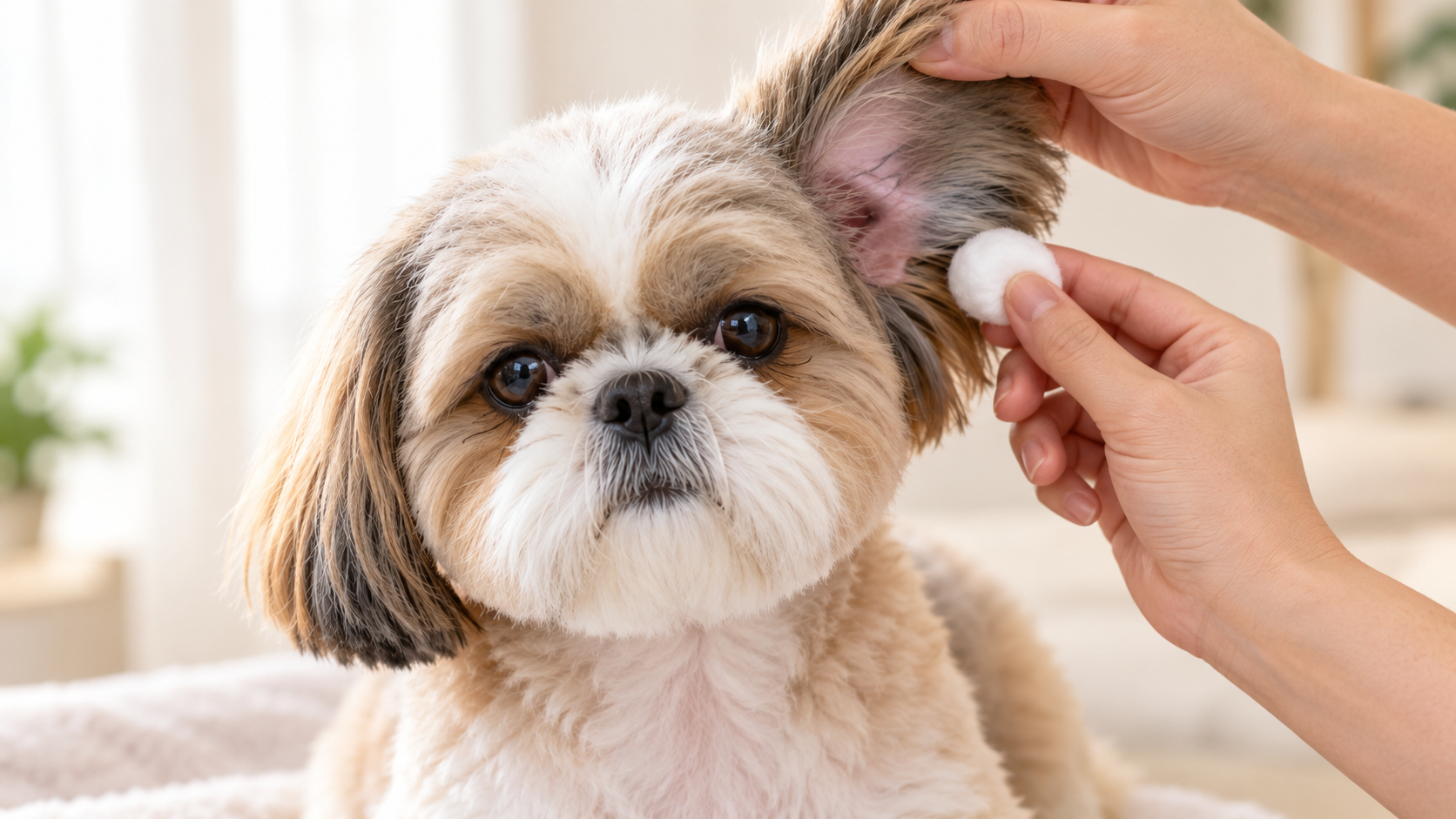
Check your Shih Tzu’s ears once a week and clean them only when you see wax or debris, using a vet-approved dog ear cleaner: fill the canal, massage the base, let your dog shake, then wipe what you can see with cotton. Never use cotton swabs, alcohol or hydrogen peroxide. Dry the ears after every bath. Redness, a bad smell, dark discharge, head shaking or a swollen ear flap means a vet visit, not more cleaning.
- Look and sniff weekly
- Clean only when dirty
- No cotton swabs, ever
- Dry ears after baths
- Ask your vet before plucking ear hair
A Shih Tzu’s ears hide under a curtain of long hair, which makes them easy to forget. That’s the problem. Hanging ear flaps and hair growing inside the canal keep the ear warm and less ventilated, and an infection can be well under way before you notice a smell or see your dog shaking its head.
The fix isn’t constant cleaning. Over-cleaning, or cleaning a sore ear, can make things worse. This guide covers a quick weekly check, how to clean safely when it’s needed, the ear-hair plucking debate, and the signs that mean your Shih Tzu needs a vet.
01
Are Shih Tzus prone to ear infections?
Their ears have known risk factors: hanging ear flaps and hair inside the ear canal. But a large UK study didn’t find Shih Tzus more likely to get ear infections than crossbreed dogs. The honest answer: the risk is real but manageable with routine checks.
The evidence is more mixed than most breed guides suggest:
- The case for extra risk. PetMD notes that Shih Tzus are prone to ear infections because hair grows inside the ear canal and can trap moisture. VCA says breeds with large, floppy or hairy ears are more prone in general.
- Hanging ears raise the odds. In a 2021 VetCompass study of over 22,000 UK dogs, those with pendulous (hanging) ears had 1.76 times the odds of outer ear infection compared with dogs whose ears stand up.
- But the breed itself didn’t stand out. In the same study, the Shih Tzu’s odds were about the same as crossbreeds’. Breeds like the Basset Hound, Shar Pei and Beagle were at much higher risk.
So treat Shih Tzu ears as worth a weekly look, not as a problem waiting to happen. Allergies are a bigger driver than many owners realize: VCA says they’re involved in up to 43% of ear infection cases, especially ones that keep coming back. See our Shih Tzu skin allergies guide. Our guide to common Shih Tzu health issues covers how ears fit into the breed’s overall health.
02
How do you check a Shih Tzu’s ears?
Once a week, lift each ear flap, look inside and take a sniff. A healthy ear is pale pink, with little or no wax and no strong smell. Redness, dark discharge, a sour or yeasty smell, or your dog flinching are signs to call your vet.
- Lift the ear flap and part the hair so you can see the opening of the canal.
- Look at the skin. It should be pale pink, not red, swollen, scaly or crusty.
- Check for wax. A little light wax is normal. Lots of brown, black or yellow discharge isn’t.
- Sniff. Healthy ears smell of very little. A strong, sour or yeasty smell is a warning sign.
- Watch your dog’s reaction. Pulling away, whining or tilting the head while you touch the ear can mean pain.
Pair it with brushingThe easiest way to remember a weekly ear check is to do it during a brushing session. You’re already parting the hair around the head. Our Shih Tzu grooming guide covers the full weekly routine.
03
How do you clean a Shih Tzu’s ears?
Use a vet-approved dog ear cleaner. Fill the ear canal, massage the base of the ear for several seconds, let your dog shake its head, then wipe the visible part of the ear with a cotton ball. Repeat until the cotton comes away clean. Never push anything into the canal.
PetMD advises cleaning when you notice a buildup of wax or debris, rather than on a fixed schedule. Dogs that bathe often, have hairy ears or have a history of ear infections may need routine cleaning, so ask your vet how often suits your Shih Tzu.
- Gather your supplies: a vet-approved dog ear cleaner, real cotton balls (Merck specifies cotton, not polyester) and a towel. Clean somewhere easy to wipe, because your dog will shake.
- Hold the ear flap up and gently away from the head to straighten the canal.
- Fill the canal with cleaner, following the product label.
- Massage the base of the ear until you hear a soft squishing sound. This loosens wax deeper in the canal.
- Let your dog shake its head to bring loosened debris up.
- Wipe what you can see with a cotton ball. Repeat until it comes away clean. PetMD says heavy buildup can take three or four rounds.
- Reward your dog and keep it short and positive.
Don’t clean an ear that looks sorePetMD advises against cleaning at home if the ear is red, painful, smelly or injured, or if the eardrum might be damaged. VCA warns that some products can cause hearing loss if the eardrum is ruptured. Let your vet look first.
What not to use: PetMD warns against alcohol, hydrogen peroxide and essential oils, and both PetMD and Merck say never to use cotton swabs in the ear, because they push debris deeper. Merck also advises avoiding over-the-counter wax removers unless your vet approves.
Need a cleaner? See our best ear cleaner for Shih Tzus, with ingredients and label directions checked.
Ears are one part of the routine.
Brushing, bathing, eyes, nails and teeth: the full Shih Tzu grooming routine in one place.
Read the Shih Tzu grooming guide04
Should you pluck your Shih Tzu’s ear hair?
Not routinely, and not yourself. Vets are split: plucking can help dogs with recurring ear infections, but it can also irritate a healthy ear. For most Shih Tzus, keeping the hair around the ear opening trimmed is enough. Ask your vet before anyone plucks.
Groomers have traditionally plucked hair from inside Shih Tzu ears, but there’s no clear rule. When a veterinary dermatologist, Dr. Laura Wilson, was asked whether to pluck, her answer was simply “it depends.”
- When it may help: FirstVet notes that dogs with chronic ear infections or heavy wax buildup may benefit, because less hair improves airflow and makes ear medication easier to apply.
- The risk: FirstVet also warns that plucking can cause tiny tears in the ear canal that let bacteria in. If a dog has no ear problems, it sees no reason for regular plucking.
- Who should do it: The Shih Tzu Club (UK) advises that hair inside the ear canal should be removed by an experienced person, not at home on a whim.
- The middle ground: Ask your groomer to trim the hair around the ear opening so air can circulate, and tell them whether your vet wants the canal hair left alone.
05
What are the signs of an ear infection in a Shih Tzu?
Head shaking, scratching at the ears, redness, a bad smell, and black or yellowish discharge. Long-standing infections can make the ear crusty or thickened. A puffy, swollen ear flap is a separate problem that also needs a vet.
| What you notice | What it can mean | What to do |
|---|---|---|
| A little light wax, no smell | Normal | Clean only if there’s buildup |
| Head shaking or scratching at the ears | Itch or pain, often infection or allergies | See your vet |
| Red, swollen skin inside the ear | Inflammation or infection | See your vet; don’t clean it first |
| Bad smell, black or yellowish discharge | Bacterial or yeast infection, or ear mites | See your vet |
| Crusty, thickened or narrowed ear canal | Chronic (long-term) infection | See your vet |
| Puffy, warm, swollen ear flap | Aural haematoma (blood blister) from head shaking | See your vet soon |
| Head tilt, loss of balance, walking in circles | Possible middle or inner ear problem | See your vet promptly |
Why you need a vet, not drops from the shelf: VCA explains that a vet checks the eardrum with an otoscope and looks at a sample under the microscope to choose the right treatment. The cause could be bacteria, yeast, mites, an allergy or something stuck in the ear, and each needs different care. Nearly all diagnosed ear infections can be managed, VCA says, but untreated ones can damage the eardrum and cause permanent hearing loss.
The swollen ear flapPDSA describes an aural haematoma as a blood-filled swelling of the ear flap, usually caused by head shaking or scratching from an itchy or infected ear. Contact your vet as soon as you notice one, and never try to drain it at home.
06
How can you prevent ear problems in a Shih Tzu?
Keep the ears dry after baths, check them weekly, keep hair around the ear opening tidy, finish any ear medication your vet prescribes, and ask about allergies if infections keep coming back.
- Dry the ears after every bath. Water left in the ear keeps it damp. Gently dry the outer ear and the hair around it with a towel, and ask your vet whether a drying ear cleaner after baths suits your dog.
- Keep shampoo out. Washing the face and head with a damp cloth instead of pouring water over the head keeps both water and shampoo out of the ears. Our best shampoo for Shih Tzu tear stains includes gentle, tearless options.
- Treat the cause of repeat infections. VCA says underlying problems such as allergies or an underactive thyroid must be treated too, or infections tend to come back. If your Shih Tzu has had several, ask your vet about allergy testing or a diet trial.
- Finish the treatment. Use prescribed ear medication for the full course, and go back for recheck appointments. VCA notes several rechecks may be needed.
- Get puppies used to ear handling. A puppy that’s comfortable having its ears touched is much easier to check and treat for life. VCA notes ear mites are more common in puppies. See our new Shih Tzu puppy checklist.
Eyes need the same kind of weekly attention. See our Shih Tzu eye care guide.
07
Shih Tzu ear care FAQs
How often should I clean my Shih Tzu’s ears?
Check them weekly, but clean only when you see wax or debris building up. Dogs that bathe often or have a history of ear infections may need more regular cleaning, so ask your vet what suits your Shih Tzu. Over-cleaning a healthy ear isn’t helpful.
What can I use to clean my Shih Tzu’s ears?
A vet-approved dog ear cleaner and real cotton balls. Don’t use alcohol, hydrogen peroxide, essential oils or cotton swabs, which can irritate the ear or push debris deeper into the canal.
Why does my Shih Tzu’s ear smell bad?
A strong, sour or yeasty smell usually points to an ear infection, often bacterial or yeast, sometimes linked to allergies. Don’t try to clean it away. Have your vet examine the ear, because the right treatment depends on the cause.
Should Shih Tzu ear hair be plucked?
Not routinely. Plucking may help dogs with recurring ear infections, but it can irritate a healthy ear canal. For most Shih Tzus, trimming the hair around the ear opening is enough. Ask your vet before anyone plucks ear hair.
Why does my Shih Tzu keep shaking its head?
Frequent head shaking usually means the ears are itchy or sore, often from an infection, allergies, ear mites or something stuck in the ear. See your vet. Constant shaking can also cause a painful swollen ear flap called an aural haematoma.
Sources
- Frequency and predisposing factors for canine otitis externa in the UK (O’Neill et al., Canine Medicine and Genetics, 2021)
- Ear Infections in Dogs (VCA Animal Hospitals)
- How to Clean Your Dog’s Ears (Merck Veterinary Manual)
- How To Clean Your Dog’s Ears (PetMD, Joel DeJaynes, DVM)
- Aural Haematoma in Dogs (PDSA)
- Is It OK to Pluck the Hair From My Dog’s Ears? (FirstVet)
- Otitis quandary: To pluck or not to pluck hair in the ear? (dvm360)
- Shih Tzu breed guide (PetMD)
Update log
- : Published. Ear care advice checked against the veterinary sources above.
This is general information, not veterinary advice. Consult your vet before making changes to your dog’s diet or care.