
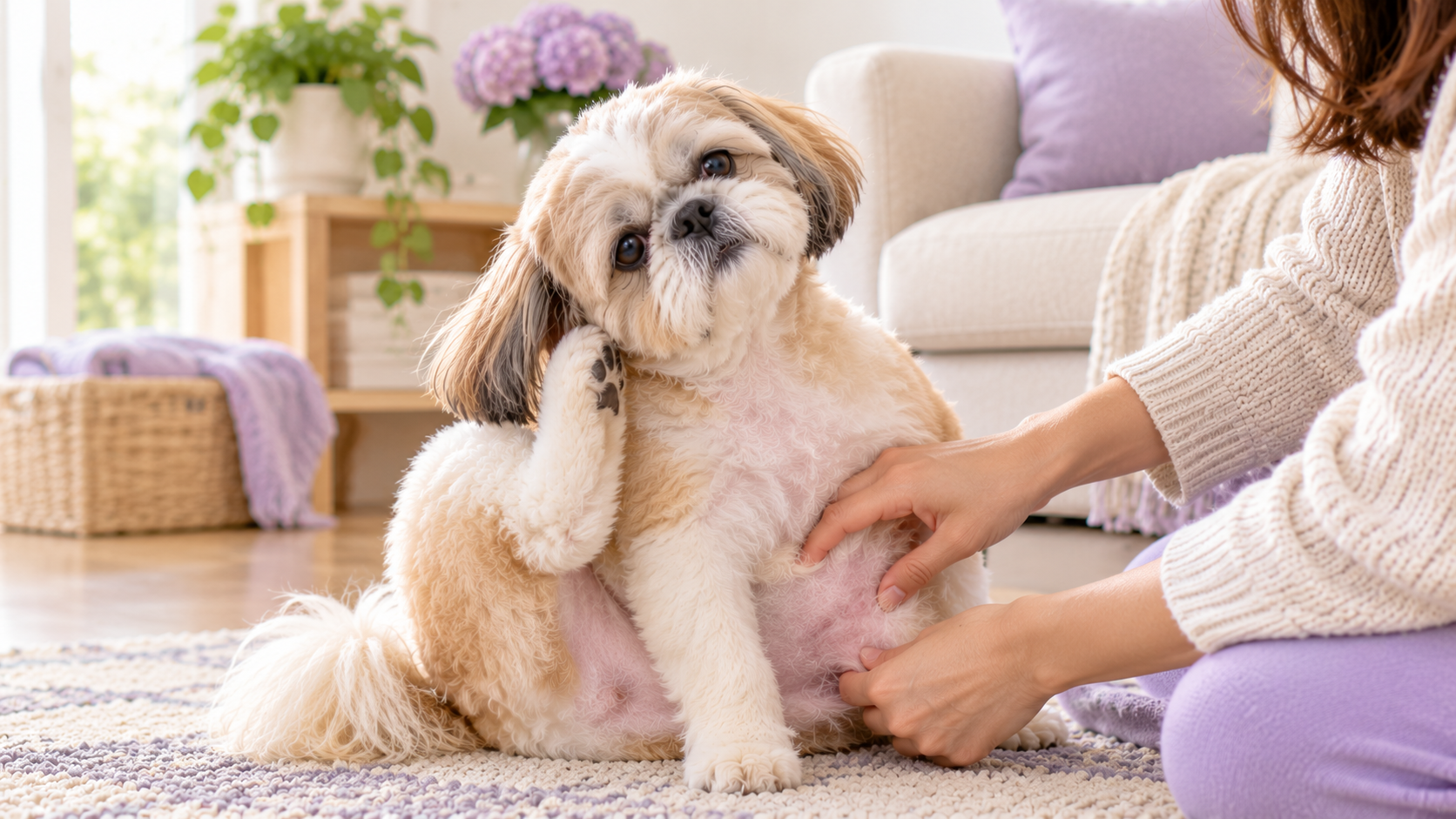
Most itchy Shih Tzus have one of three underlying problems: flea allergy, environmental allergies (atopic dermatitis, which the Merck Veterinary Manual lists Shih Tzus as predisposed to), or, less often, a food allergy. Yeast and bacterial skin infections often follow and make the itch worse; Shih Tzus are also predisposed to Malassezia yeast dermatitis. Start with year-round flea prevention, keep the coat clean, dry and mat-free, and see your vet for persistent itching. Food allergy can only be confirmed with a strict elimination diet of at least 8 weeks; hair, saliva and blood food-allergy tests aren’t reliable.
- Fleas first: year-round prevention for every pet
- Where it itches is a clue
- Yeast often follows allergies
- Elimination diet: 8+ weeks, strict
- Skip hair and saliva allergy tests
A Shih Tzu that won’t stop licking its paws, scratching its belly or rubbing its face on the carpet is miserable, and so is its owner. Many of the top articles on Shih Tzu skin allergies are written by pet food companies, and unsurprisingly, a lot of them point to a change of food as the fix.
Food allergy is real, but it’s not the most common cause of itching. This guide covers what usually is, how to narrow it down from where your dog itches, how vets diagnose allergies (and which tests to skip), and how a Shih Tzu’s coat and face affect skin care.
01
Are Shih Tzus prone to skin allergies?
Yes. The Merck Veterinary Manual lists the Shih Tzu among breeds predisposed to atopic dermatitis, an inherited tendency to develop itchy skin allergies to environmental allergens. Veterinary dermatology sources also list Shih Tzus among breeds at higher risk of Malassezia yeast dermatitis, which often develops on top of allergies.
- Atopic dermatitis: signs usually start between 6 months and 3 years of age, Merck notes, and can be seasonal at first, then year-round.
- Yeast: the Canadian Veterinary Journal lists the Shih Tzu among breeds with an increased risk of Malassezia dermatitis, which is usually secondary to allergies.
- Risk varies. Merck notes breed risk depends on the local gene pool and region, so it’s a tendency, not a certainty.
- The coat matters. A long, dense coat can hide fleas, trap moisture after baths and form mats that rub and irritate the skin underneath.
02
What causes itchy skin in Shih Tzus?
The main causes are flea allergy, environmental allergies (pollen, dust mites, molds), food allergy, and secondary yeast or bacterial infections. Mites, irritating products, mats and damp coat can also cause or worsen itching. Many dogs have more than one problem at once.
| Cause | What you might notice | Shih Tzu angle |
|---|---|---|
| Flea allergy | Itching, redness and hair loss at the tail base, rump and back legs; flea dirt in the coat | Fleas hide easily in a long coat; one bite can set off days of itching |
| Environmental allergy (atopic dermatitis) | Licking paws, rubbing face, scratching armpits and belly, recurring ear problems | Shih Tzus are listed as predisposed (Merck) |
| Food allergy | Similar itching to atopic dermatitis, year-round; sometimes stomach upsets | Can only be confirmed with an elimination diet |
| Yeast (Malassezia) | Greasy, smelly skin; redness between toes, around lips, in skin folds and ears; darkened skin | Shih Tzus are listed as predisposed; often follows allergies |
| Bacterial skin infection | Red bumps, pustules, crusts, circular scaly patches | Often follows scratching |
| Mites (mange) | Intense itching, crusting on ears, elbows and belly | Needs a vet’s skin scraping; some types spread to other pets |
| Mats and damp coat | Sore, red or smelly skin under mats; hot spots | A coat left damp after a bath or a long, matted coat is a common trigger |
| Irritating products | Itching after a new shampoo, spray or cleaner | Scented grooming sprays and human shampoos can irritate |
03
Where your Shih Tzu itches can point to the cause
Itching at the tail base and rump points to fleas. Itchy paws, face, ears, armpits, inner front legs and belly fit environmental or food allergies. Greasy, smelly redness between the toes, around the lips or in face folds suggests yeast. These are clues, not a diagnosis, so share what you see with your vet.
- Tail base and rump: veterinary dermatologist Dr. Mitzi Clark of Cornell, quoted by Rover, calls red, irritated skin around the base of the tail and rump classic signs of flea allergy.
- Feet, face, ears, armpits, belly: Merck lists the feet, face, ears, front leg folds, armpits and abdomen as the areas most often affected by atopic dermatitis.
- Ears only: Merck notes recurring ear infections can be the only sign of atopic dermatitis in some dogs. See our Shih Tzu ear care guide.
- Rusty-brown fur on paws or legs: saliva staining from constant licking, which shows clearly on a light Shih Tzu coat.
- Around the eyes: brown staining there is usually tear staining, but red, itchy, greasy skin is worth a vet check. See our tear stains guide.
04
How do vets diagnose skin allergies in a Shih Tzu?
By ruling things out. Your vet will usually check for fleas and mites, look at skin samples under a microscope for yeast and bacteria, treat any infection, and make sure flea control is strict. If itching continues, a strict elimination diet tests for food allergy. Atopic dermatitis is diagnosed from the history and signs once other causes are ruled out, not from a lab test.
- Parasites: flea combing, and skin scrapings for mites.
- Infection: skin cytology (tape or swab samples under the microscope) is the most practical way to find Malassezia yeast, according to the Canadian Veterinary Journal.
- Flea control trial: strict, year-round prevention for every pet in the home.
- Elimination diet: for at least 8 weeks if itching continues (see below).
- Atopic dermatitis: diagnosed from signs, history and ruling out other causes. Merck says diagnosis is “not on laboratory tests.”
- Allergy testing (skin or blood tests for environmental allergens) is used after diagnosis to choose ingredients for immunotherapy, not to make the diagnosis.
Skip hair, saliva and blood food-allergy testsA 2017 review in BMC Veterinary Research found serum food-allergy tests had low repeatability and highly variable accuracy in dogs, and concluded an elimination diet remains the best way to diagnose food allergy. A 2019 study in the Journal of Small Animal Practice found a hair and saliva test failed to identify allergies in dogs. These tests are widely sold online but can send you down the wrong path.
05
Does my Shih Tzu have a food allergy?
Possibly, but you can only find out with a strict elimination diet: a prescription hydrolyzed diet or a protein your dog has never eaten, fed with nothing else for at least 8 weeks, then a “challenge” with the old food to see if itching returns. Ask your vet to plan it.
- Strict means strict. No treats, table scraps, flavored chews, flavored medications or dental chews unless your vet approves them.
- Long enough. Olivry and colleagues (2015) recommend at least 8 weeks for skin signs; shorter trials can miss a food allergy.
- Re-challenge. Going back to the old food and seeing the itch return is what confirms the diagnosis.
- “Grain-free” isn’t a test. A 2016 review in BMC Veterinary Research found the most commonly reported food allergens in dogs were beef, dairy, chicken and wheat, so dropping grain alone often misses the trigger. Switching between store foods rarely gives a clear answer.
- Kibble size still matters. A flat-faced Shih Tzu may struggle with large kibble, so ask your vet about diet options in a small kibble or wet form.
For everyday feeding, see our Shih Tzu feeding guide.
Keeping the coat clean and mat-free
The full brushing, bathing and drying routine for a Shih Tzu’s double coat.
Read the grooming guide06
How can you help a Shih Tzu with itchy skin at home?
Keep every pet on year-round flea prevention, brush out mats, bathe with a gentle or vet-recommended shampoo and dry the coat right down to the skin, wipe paws after walks, and wash bedding often. These steps support your vet’s treatment; they don’t replace it.
- Year-round flea prevention for every pet. Veterinary dermatologist Dr. Alexandra Gould, quoted by Rover, calls this the most important step.
- Prevent mats. Mats trap moisture and debris against the skin. Regular brushing with the right tools helps: see our best brushes for Shih Tzus.
- Consider a shorter cut. A puppy cut is easier to keep clean and dry. See our Shih Tzu haircut styles.
- Bathe and dry properly. Use the shampoo your vet recommends; medicated shampoos often need several minutes of contact. Dry thoroughly, including armpits, groin, ears and paws, where yeast thrives.
- Wipe paws and belly after walks in pollen season.
- Watch the rear. Allergic dogs often scoot or lick their bottoms; see our Shih Tzu anal glands guide.
- Keep the face clean. Wipe food and tears from the beard and face folds daily.
- Wash bedding weekly in hot water. A bed with a removable, washable cover helps: see our best dog beds for Shih Tzus.
07
What should you avoid with an itchy Shih Tzu?
Don’t give human antihistamines or other medicines without your vet’s advice, don’t put essential oils, tea tree oil or vinegar on irritated skin, don’t keep switching foods at random, don’t rely on hair or saliva allergy tests, and don’t shave the coat to the skin.
- No medicines without your vet. Some human products contain ingredients that are dangerous for dogs, and doses for a 9–16 lb dog are very different.
- No essential oils on the skin. Many are irritating or toxic to dogs; tea tree oil is a common culprit.
- No human shampoo or frequent baths with harsh products, which can dry and irritate skin.
- Don’t shave to the skin. The ASPCA advises trimming rather than shaving, because the coat protects against sunburn and overheating.
- Don’t wait out a hot spot. Red, wet, painful patches can spread fast under a long coat.
08
When should you take an itchy Shih Tzu to the vet?
See your vet if itching lasts more than a week or two, keeps your dog awake, or comes with hair loss, red or broken skin, scabs, hot spots, a greasy smell, darkened skin, head shaking or ear odor. A young puppy with intense itching should be checked for mites.
- Treatment is available. Vets have fast-acting anti-itch medicines, medicated shampoos, and treatments for infection. Merck notes atopic dermatitis can’t be cured but can be managed in most dogs.
- Long-term options. Allergy immunotherapy is the only treatment that can change the immune response to allergens, Merck says, but it can take 3–12 months to work.
- Flare-ups happen. Fleas, infections and allergy seasons can trigger them. A plan with your vet makes them easier to handle.
- Related problems: see our guides to common Shih Tzu health issues and ear care.
09
Shih Tzu skin allergy FAQs
Why is my Shih Tzu so itchy?
The most common causes are flea allergy, environmental allergies (atopic dermatitis) and, less often, food allergy. Yeast and bacterial infections often develop on top of allergies and make itching worse. Mats, a damp coat and irritating products can add to it. Your vet can help find the cause.
What are Shih Tzus most allergic to?
There’s no single answer. Flea saliva, environmental allergens such as pollen and dust mites, and food proteins are the main triggers. The Merck Veterinary Manual lists Shih Tzus as predisposed to atopic dermatitis, the environmental allergy form.
Are dog allergy tests accurate?
Hair and saliva tests, and blood tests for food allergies, aren’t reliable for dogs, according to veterinary dermatology research. A strict elimination diet of at least 8 weeks is the best way to diagnose food allergy. Skin or blood tests for environmental allergens are used to plan immunotherapy after a vet diagnoses atopic dermatitis.
Can I give my Shih Tzu Benadryl for itching?
Only if your vet says so and gives you the dose. Antihistamines often don’t help much with allergic itching in dogs, and some human products contain other ingredients that are dangerous for dogs.
Can changing food stop my Shih Tzu’s itching?
Only if the itching is caused by a food allergy, which has to be confirmed with a strict elimination diet planned by your vet. Randomly switching store foods rarely helps and makes it harder to find the real cause.
Sources
- Canine atopic dermatitis (Merck Veterinary Manual)
- Canine Malassezia dermatitis (Bajwa, Canadian Veterinary Journal, 2017)
- Malassezia species and its significance in canine skin disease (Bajwa, Canadian Veterinary Journal, 2023)
- Can we diagnose adverse food reactions in dogs and cats with in vivo or in vitro tests? (Mueller & Olivry, BMC Veterinary Research, 2017)
- Duration of elimination diets (Olivry, Mueller & Prélaud, BMC Veterinary Research, 2015)
- Common food allergen sources in dogs and cats (Mueller, Olivry & Prélaud, BMC Veterinary Research, 2016)
- Hair and saliva test fails to identify allergies in dogs (Coyner & Schick, Journal of Small Animal Practice, 2019)
- Dog flea allergy dermatitis (Rover, with veterinary dermatologists quoted)
Update log
- : Published. Health information checked against the sources above.
This is general information, not veterinary advice. Consult your vet before making changes to your dog’s diet or care.