
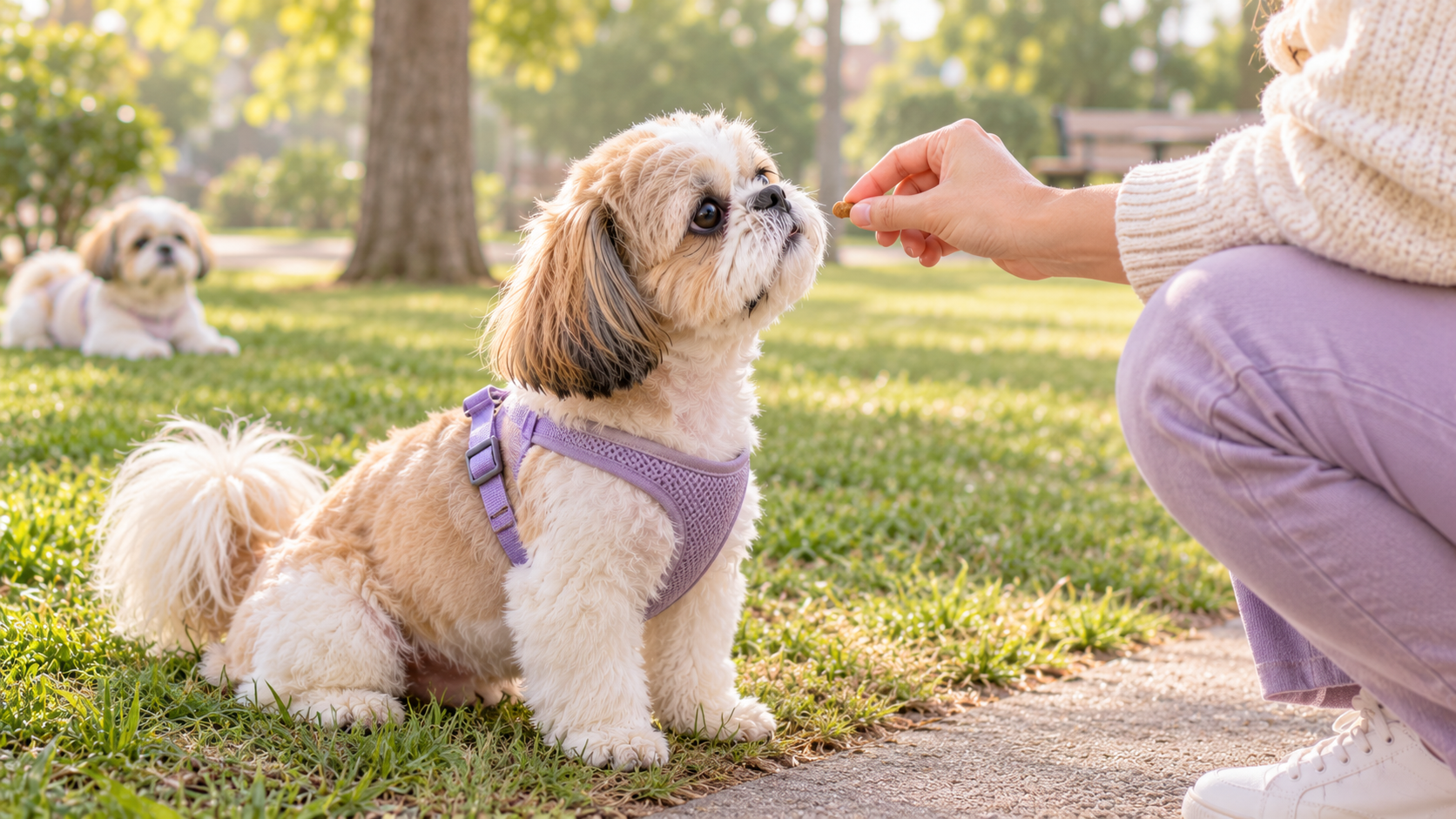
Socialize a Shih Tzu puppy by giving it short, positive experiences with new people, calm dogs, sounds, surfaces, places and handling, starting as soon as it comes home. AVSAB calls the first three months the most important window, and puppy classes can start at 7–8 weeks, at least 7 days after the first vaccines. Go at your dog’s pace, reward calm curiosity, and back off at the first sign of fear. For a small, flat-faced dog, choose small-dog play only, a harness rather than a collar, and cool times of day. Adult and rescue Shih Tzus can still learn, just more slowly.
- Start right away; don’t wait for all vaccines
- Short, happy, never forced
- Small-dog playmates only
- Practice grooming and face handling daily
- Fear or growling: talk to your vet
Shih Tzus are bred as companions, and most are friendly by nature. But a friendly temperament isn’t the same as a well-socialized dog. A Shih Tzu that never got used to strangers, big dogs, the groomer’s dryer or having its face wiped can grow into a dog that barks at visitors, panics at the groomer or snaps when its eyes are cleaned.
Most socialization advice online is generic, unsourced, or skips the details that matter for this breed: a 9–16 lb body that a big dog can injure in play, a flat face that overheats, and a lifetime of grooming and face care. This guide covers all of that, plus what to do if you’ve adopted an adult or rescue Shih Tzu.
01
What does socializing a Shih Tzu actually mean?
Socialization means helping your Shih Tzu have calm, positive experiences with the people, animals, places, sounds and handling it will meet in life, so new things feel safe rather than scary. It isn’t about meeting as many dogs as possible, and it never means forcing a frightened dog to “face its fears.”
- Quality beats quantity. One calm meeting with a gentle adult is worth more than a chaotic dog park visit.
- Your puppy sets the pace. AVSAB advises exposing puppies to as much as possible “without causing overstimulation manifested as excessive fear, withdrawal or avoidance behavior.”
- Pair new things with good things. Small treats, praise and play make a new experience a good memory.
- It includes being alone. AVSAB also recommends short spells of alone time with toys and naps in a crate or pen. See our Shih Tzu separation anxiety guide.
02
When should you start socializing a Shih Tzu puppy?
Start the day your puppy comes home. AVSAB calls the first three months “the primary and most important time for puppy socialization,” and AAHA puts the socialization period at about 2–12 weeks. Puppy classes can start at 7–8 weeks, once your puppy has had at least one set of vaccines 7 days before the first class, plus a first deworming.
- Don’t wait for the full vaccine series. AVSAB warns that behavior problems, not infectious diseases, are the number one cause of death for dogs under three years old.
- But be smart about germs. AVSAB advises avoiding places that aren’t sanitized and are heavily used by dogs of unknown vaccine status, such as dog parks. Choose classes held indoors on easy-to-clean floors that check vaccine records.
- Expect a wobbly patch. AAHA notes many puppies go through a fear period around 8–10 weeks, often just as they move to a new home and see the vet for the first time. Keep things extra gentle then.
- It doesn’t stop at 12 weeks. Keep up regular positive experiences through the first year and beyond, or skills can fade.
For the full first-weeks plan, including vaccines and what to buy, see our new Shih Tzu puppy checklist.
03
What should a Shih Tzu socialization checklist include?
Cover people, other animals, sounds, surfaces, places, car rides, handling and grooming, and alone time. Aim for a few short, positive experiences a day rather than long outings, and keep a simple list so you can see what you’ve missed.
| Area | Examples | Shih Tzu tip |
|---|---|---|
| People | Men, women, children, people in hats, glasses or uniforms, people using wheelchairs or walkers | Have guests crouch and let your puppy approach; small dogs are often scooped up by strangers without warning |
| Other dogs | Calm, vaccinated adult dogs; puppies of a similar size | Choose gentle, small playmates; skip rough play with big dogs |
| Other animals | Cats, birds, farm animals at a distance | Watch from a distance with treats first |
| Sounds | Doorbell, vacuum, traffic, thunder and fireworks recordings at low volume, hair dryer | Start quiet and build up; helps prevent alert barking later |
| Surfaces | Grass, tile, carpet, metal grates, a grooming table, a bathtub mat | A non-slip mat on the grooming table helps a small dog feel secure |
| Places | Quiet streets, a pet-friendly shop, the vet’s waiting room for a “happy visit” | Go in the cool part of the day; flat-faced dogs overheat easily |
| Car rides | Short trips that end somewhere nice, not just the vet | Use a secured crate or car harness |
| Handling and grooming | Paws, nails, ears, mouth, face wiping, brushing, the dryer | The most important area for this breed (see below) |
| Alone time | A few minutes in a pen or crate with a chew toy | Builds up to longer absences later |
Make it a gameKeep a pouch of tiny treats or part of your puppy’s daily food with you. Reward calm interest in anything new. Treats should stay under 10% of daily calories, and Shih Tzus gain weight easily, so use pea-sized pieces.
04
How do you socialize a Shih Tzu safely around bigger dogs and people?
Choose calm, small playmates and size-matched puppy classes, keep greetings short, and step in before play gets rough. A friendly large dog can still injure a 9–16 lb Shih Tzu by accident, and one bad experience can create lasting fear.
- Size-matched play. A Shih Tzu breeder quoted by the AKC advises choosing puppy classes where the dogs are the same size, not necessarily the same age.
- Skip the dog park. Besides the germ risk AVSAB warns about, dog parks mix sizes and play styles you can’t control.
- Use a harness, not a collar. A collar presses on a flat-faced dog’s airway when it pulls toward something exciting. See our best harness for Shih Tzus.
- Let your dog use its own feet. Being carried everywhere means a small dog never learns to cope at ground level. Pick up your Shih Tzu only to get it out of real danger, such as an off-leash dog charging in.
- Be your dog’s advocate. It’s fine to say “no thanks” to a stranger who wants to pick up your puppy, or to an owner whose dog is pulling hard to greet.
- Watch the heat. Short sessions, shade and water. Heavy panting in a flat-faced dog can be heat or airway strain, not just excitement. See our Shih Tzu hot weather guide.
Barking at visitors or other dogs?
Work out which type of barking it is, and fix it with reward-based steps.
Read the barking guide05
How do you get a Shih Tzu used to grooming and handling?
Touch one body part briefly, give a treat while you touch, and stop the treats when you stop. Build up slowly to paws, nails, ears, mouth and the face around the eyes, then add the brush, comb, nail clippers and dryer. A Shih Tzu will be groomed and have its face cleaned for life, so this is the most valuable socialization you can do.
- Pick a calm spot and three treats your dog loves.
- Start with an easy touch, like stroking the chest or side, and feed treats during the touch. When the touch stops, the treats stop.
- Move on slowly: paws, then holding a paw, then touching a nail; ears; lifting the lips; wiping under the eyes.
- Add the tools: let your puppy sniff the brush and comb, then use them for a few strokes. Run the dryer on low across the room before using it near your dog.
- Watch for comfort. If your dog stiffens, turns away or stops taking treats, go back a step.
- Keep sessions short and end while your dog is still happy.
This approach, pairing gentle handling with food and progressing only while the dog is relaxed, follows Purdue University’s Canine Welfare Science guidance on body handling. Their handout notes that as little as 30 seconds of handling a day has been linked to greater sociability toward people. For full routines, see our Shih Tzu grooming guide, eye care guide and nail trimming guide.
Book a “happy visit” with the groomerMany groomers will let a puppy visit just to sniff around, get a treat and hear the dryer before its first real groom. That’s far easier than a full groom as a first experience.
06
How can you tell if your Shih Tzu is scared?
Look at the whole dog. Signs of fear or stress include a tucked tail, leaning or backing away, crouching, trembling, freezing, lip licking, yawning, a closed mouth with the lips pulled back, sudden panting, raised hackles, and looking or turning away. If you see them, give your dog more distance and make the situation easier.
| Relaxed | Worried or scared |
|---|---|
| Loose, wiggly body; play bow | Leaning back, crouching, trembling, freezing |
| Open, relaxed mouth | Mouth closed tight, lips pulled back at the corners; lip licking, yawning |
| Soft, almond-shaped eyes | Wide eyes showing more white, or looking away |
| Tail neutral or wagging loosely | Tail tucked or held stiff; stiff wag |
| Sniffing and exploring | Trying to hide behind you, or scratching and sniffing to avoid something |
Source: ASPCA canine body language guide.
- Breed caution: a Shih Tzu’s large, prominent eyes and long facial hair can make eye whites and ear position harder to read. Rely on posture, tail and whether your dog will still take a treat.
- Panting isn’t always stress. In a flat-faced dog it may be heat or breathing effort. Move somewhere cool and see if it settles.
- A dog that won’t eat is over its limit. Increase the distance or end the session.
07
Can you socialize an adult or rescue Shih Tzu?
Yes, but expect slower progress and focus on helping your dog feel safe rather than meeting everyone. Start at a distance where your dog stays calm, pair the trigger with treats, and move closer in small steps over days or weeks. Never force contact. If your dog growls, snaps or seems afraid all the time, see your vet and a qualified behavior professional.
- Give a settling-in period. A newly adopted dog needs a calm routine before new challenges.
- Find the “working distance.” Start far enough from the trigger, such as another dog across the street, that your dog notices it but stays relaxed. Reward, then end on a good note.
- Back up if you see fear. If your dog reacts, you’ve gone too far; next time, start further away.
- Let people be boring. Ask visitors to ignore your dog and toss treats, so your dog chooses when to approach.
- Handling still counts. Use the same treat-while-touching method above. Adult and fearful dogs usually need slower steps.
- Rule out pain. New grumpiness about handling, especially around the back, ears or mouth, can be pain. See our guide to common Shih Tzu health issues.
08
When should you get help with a fearful Shih Tzu?
Talk to your vet if your Shih Tzu shows fear of or withdrawal from people or dogs, aggression, new phobias (storms, car rides, walks), distress when left alone, or increasing reactivity. AVSAB advises owners of fearful puppies to seek veterinary guidance early.
- Start with your vet, who can check for pain or illness and refer you to a veterinary behaviorist if needed.
- Choose reward-based trainers. AVSAB recommends only reward-based methods. Avoid trainers who use shock or prong collars, or talk about being “the alpha.”
- Act early. Fear is easier to help in a young dog than in one that has practiced it for years.
09
Shih Tzu socialization FAQs
When should I start socializing my Shih Tzu puppy?
As soon as it comes home. AVSAB calls the first three months the most important socialization window. Puppy classes can start at 7–8 weeks, once your puppy has had at least one set of vaccines 7 days before the first class.
Is it too late to socialize my adult Shih Tzu?
No. Adult and rescue dogs can still learn to feel comfortable with new people, dogs and handling, but progress is slower. Work at a distance where your dog stays calm, pair new things with treats, and never force contact.
Should my Shih Tzu puppy go to a dog park?
It’s best to avoid them. AVSAB advises against unsanitized places used by dogs of unknown vaccine status, and dog parks mix sizes and play styles that can overwhelm or injure a small dog. Size-matched puppy classes and calm, vaccinated playmates are safer.
How do I get my Shih Tzu used to grooming?
Start with short, gentle handling sessions, feeding treats while you touch the paws, ears, mouth and face. Then introduce the brush, comb, clippers and dryer slowly. A “happy visit” to the groomer before the first full groom also helps.
Are Shih Tzus good with other dogs?
Many are, especially if they were socialized as puppies. Because they’re small, choose calm or size-matched playmates and step in before play gets rough.
Sources
- Position Statement on Puppy Socialization (American Veterinary Society of Animal Behavior)
- Canine Life Stage Guidelines: Behavior awareness (AAHA)
- Behavior Management Guidelines: concerning behaviors (AAHA)
- Humane Dog Training Position Statement (2021) (American Veterinary Society of Animal Behavior)
- Canine body language (ASPCA)
- Adult Dog Body Handling: Quick Tips (Purdue University Canine Welfare Science)
- How to Train a Shih Tzu Puppy (American Kennel Club)
Update log
- : Published. Behavior advice checked against the sources above.
This is general information, not veterinary advice. Consult your vet before making changes to your dog’s diet or care.