
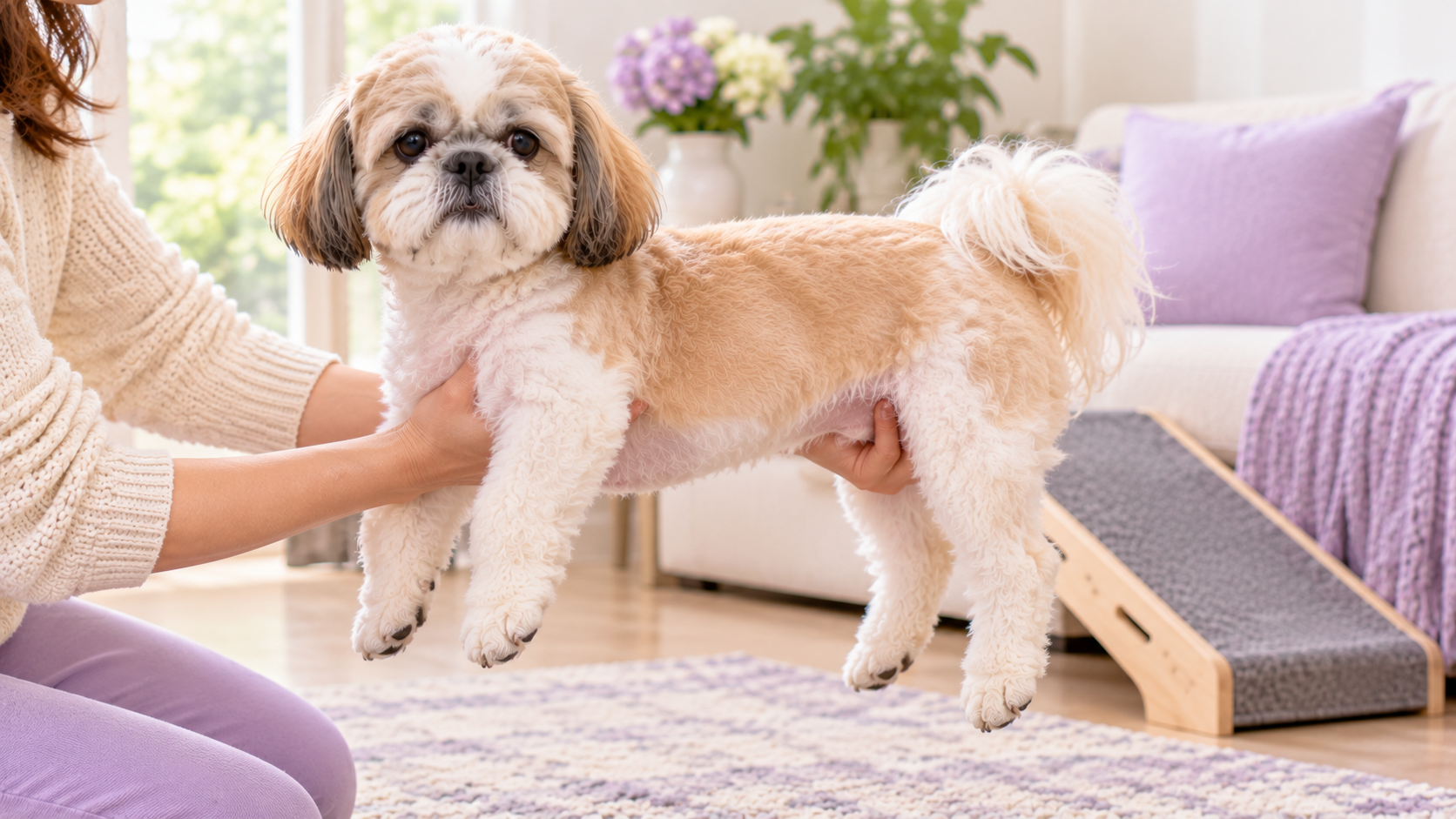
IVDD (intervertebral disc disease) happens when a spinal disc degenerates and bulges or bursts, pressing on the spinal cord. Shih Tzus are a chondrodystrophic breed, which means their discs can age early, and the AKC Canine Health Foundation lists them among the breeds most commonly affected. Signs range from back or neck pain, shivering and a hunched back to wobbly legs and paralysis. Any weakness, wobbling or loss of walking is an emergency: the outlook is best when treatment starts early. You can’t prevent IVDD completely, but a healthy weight, a harness instead of a collar, ramps and careful lifting reduce strain.
- Shih Tzus are a high-risk breed
- Neck pain counts, not just back pain
- Wobbly or can’t walk: emergency vet now
- Mild cases: strict rest and pain relief
- Severe cases: surgery, ideally fast
Most people think of IVDD as a Dachshund problem. It isn’t only that. The Shih Tzu has the same short-legged, “chondrodystrophic” body type, and it turns up in veterinary breed-risk lists, genetic studies and UK owner surveys alike.
The top articles on Shih Tzu IVDD are mostly from mobility-product sellers, with no author, no date and no sources, and they rarely mention that Shih Tzus can get disc disease in the neck. This guide covers the genetics, the early signs, how vets grade severity, real recovery figures, and the everyday changes that reduce strain on your dog’s spine.
01
What is IVDD in Shih Tzus?
The discs between the bones of the spine act as shock absorbers. In IVDD, a disc dries out and loses its cushioning. If it bulges or bursts, disc material presses on the spinal cord, causing pain, weakness and sometimes paralysis. In small chondrodystrophic breeds like the Shih Tzu, this usually happens suddenly (a “Type I” disc extrusion).
- Where it happens: Cornell notes about 65% of IVDD problems are in the back (thoracolumbar region) and about 18% in the neck alone; the rest involve both.
- Shih Tzus and the neck: a 2023 review in Frontiers in Veterinary Science notes Beagles and Shih Tzus are more commonly affected by disc herniations in the neck.
- Not always IVDD: Cornell points out that infections, soft-tissue injury, autoimmune disease and even cancer can cause similar signs, so a vet exam and imaging matter.
02
Are Shih Tzus prone to IVDD?
Yes. The AKC Canine Health Foundation names the Shih Tzu among the chondrodystrophic breeds most commonly affected, a UK Kennel Club owner survey found significantly more intervertebral disc problems in Shih Tzus than in dogs overall, and a UC Davis lab found the main IVDD risk gene in about a quarter of Shih Tzu gene copies tested.
- The gene: UC Davis researchers (Brown et al., 2017) found an extra copy of a gene called FGF4 on chromosome 12 that causes short legs and early disc degeneration. Dogs with it had dramatically higher odds of IVDD (an odds ratio of about 51).
- One copy is enough: UC Davis’s Veterinary Genetics Laboratory says the variant is dominant, so one copy raises risk. It measured an allele frequency of 0.25 in 110 Shih Tzus.
- Owner data: a Kennel Club survey (Wiles et al., 2017), cited in a 2024 VetCompass study of UK Shih Tzus, found “significantly higher prevalence” of intervertebral disc disorder in Shih Tzus than in dogs overall.
- Risk isn’t destiny: UC Davis’s paper estimated lifetime IVDD prevalence across all dogs at about 3.5%. Many Shih Tzus never have a disc episode, but the breed’s risk is higher than average.
Buying a puppy?A DNA test for the chondrodystrophy (CDDY) variant is available from several labs. Ask breeders whether they test and how they use the results; UC Davis advises breeders to reduce the variant gradually rather than all at once.
03
What are the signs of IVDD in a Shih Tzu?
Early signs include back or neck pain, a hunched back, shivering, reluctance to jump, climb stairs or be picked up, yelping when touched, and a low head carriage. More serious signs are wobbliness, weak or dragging back legs, knuckling paws, trouble standing, loss of bladder control, and paralysis.
| Where | What you might see |
|---|---|
| Back (most common) | Hunched back, tense belly, yelping when picked up, reluctance to jump or use stairs, wobbly or weak back legs, scuffing or dragging back feet |
| Neck | Head held low, won’t turn the head, reluctant to lower the head to eat or drink, crying out with no obvious cause, wobbly in all four legs in more severe cases |
| Either | Shivering or trembling, reluctance to move, hiding, snapping or growling when handled (Cornell notes even sweet dogs may snap when in pain) |
| Emergency signs | Can’t stand or walk, legs paralysed, loss of bladder or bowel control |
Can’t walk? Go now, not tomorrowThe ACVS describes disc rupture as generally a true surgical emergency. Cornell notes dogs that were “a little off in the morning” can be unable to move by the afternoon. If your Shih Tzu is wobbly, weak in the legs or can’t walk, call your vet or an emergency clinic immediately. Carry your dog flat and supported, ideally in a crate or on a board.
Shivering and hiding are easy to mistake for cold or nerves in a small dog. For more on hidden pain, see our senior Shih Tzu care guide.
04
How do vets grade IVDD?
Vets grade back IVDD from 1 (pain only) to 5 (paralysis with no deep pain sensation). The single most important sign for the outlook is whether your dog can still feel a firm pinch to the toes, called deep pain perception.
| Grade | What it means |
|---|---|
| 1 | Back pain, walking normally |
| 2 | Can walk, but wobbly or weak |
| 3 | Can move the legs but can’t walk |
| 4 | Paralysed, deep pain sensation present |
| 5 | Paralysed, no deep pain sensation |
Grades as summarized by veterinary neurologist Dr. Simon Platt in dvm360. Neck IVDD is assessed differently.
05
How is IVDD treated in Shih Tzus?
Mild, first-time cases where the dog can still walk are often treated with strict crate rest and pain relief. Dogs that can’t walk, are getting worse, or have pain that won’t settle usually need an MRI or CT scan and surgery to relieve pressure on the spinal cord. The sooner severe cases are treated, the better the outlook.
Medical (conservative) treatment
- The ACVS says conservative treatment is often only offered for a first episode with mild deficits.
- It means strict confinement: a crate or small pen, carried outside for toilet breaks, no stairs, sofas or play. Typical rest periods in veterinary references run from about 2 to 6 weeks.
- Your vet will prescribe pain relief and anti-inflammatory medication. Never give human painkillers.
- Cornell notes that if a dog on medical management gets worse, you should be ready to move quickly to surgery.
Surgery
- A specialist removes the disc material pressing on the spinal cord, after MRI or CT.
- Recovery rates from the Merck Veterinary Manual:
| Situation | Recovery after surgery |
|---|---|
| Can’t walk, back disc, deep pain present (small breed) | 85–95% |
| Deep pain lost for under 24 hours | About 50% |
| Deep pain lost for over 24 hours | Under 50% |
| Neck disc, still walking | 95% |
| Neck disc, can’t walk | 65–95% |
Cost and access to specialists are real concerns. Ask your vet about likely costs and options early, so you can decide quickly if your dog gets worse.
Cut out the jumps
Sofa and bed ramps, steps, and the slope maths for a disc-prone Shih Tzu.
See the best dog ramps06
How do you care for a Shih Tzu recovering from IVDD?
Follow your vet’s rest instructions exactly, even when your dog seems better, keep the crate padded and the floor non-slip, carry your dog outside for toilet breaks, keep the coat clean and dry, and ask about physical rehabilitation. Recovery usually takes weeks to months.
- Rest means rest. Veterinary neurologists say cage rest is the most important and most ignored part of treatment, especially once the dog starts feeling better. After surgery, the ACVS lists bed rest for at least 4 weeks.
- Toilet trips: carry your dog out on a harness and back in. Some dogs need help emptying the bladder; the ACVS mentions bladder expression 3–4 times a day if needed. Your vet will show you how.
- Coat and skin care: a dog that can’t move much, or leaks urine, can get sore, damp, matted skin quickly. A short, easy-care trim helps. See our Shih Tzu haircut styles and skin guide.
- Padded, washable bedding with a waterproof liner. See our best dog beds for Shih Tzus.
- Rehab: the ACVS includes physical rehabilitation for strength and flexibility in post-surgery recovery. Ask for a referral to a certified rehab vet.
- Recurrence: IVDD can affect more than one disc, so a dog that has had one episode needs lifelong back-friendly habits.
07
Can you prevent IVDD in a Shih Tzu?
Not completely, because the main risk is genetic. But you can reduce strain on the spine: keep your Shih Tzu at a healthy weight, use a harness instead of a collar, add ramps or steps to furniture, lift with the spine supported, and keep your dog fit with regular, moderate exercise.
- Healthy weight. The AKC Canine Health Foundation notes obese dogs of predisposed breeds are especially at risk. See our feeding guide.
- Harness, not collar. Pulling on a collar presses on the neck, where Shih Tzus can also have disc problems. See our best harness for Shih Tzus.
- Ramps and steps. Research on jumping is limited and mostly from Dachshund owner surveys, so treat ramps as a sensible precaution rather than proven prevention. For a dog that’s already had an episode, they’re essential. See our best dog ramps and steps.
- Lift correctly. One hand under the chest, one under the back end, keeping the spine level. Don’t lift by the front legs or under the armpits alone.
- Regular, moderate exercise keeps the muscles that support the spine strong. See our Shih Tzu exercise guide.
- Non-slip floors. Runner rugs on slippery floors reduce sudden twists and slips.
08
Shih Tzu IVDD FAQs
Are Shih Tzus prone to IVDD?
Yes. The AKC Canine Health Foundation lists the Shih Tzu among the chondrodystrophic breeds most commonly affected by intervertebral disc disease, and UC Davis found the main IVDD risk gene variant at a frequency of about 25% in Shih Tzus tested.
What are the first signs of IVDD in a Shih Tzu?
Back or neck pain, a hunched back, shivering, reluctance to jump, use stairs or be picked up, holding the head low, and yelping when touched. Wobbly or weak back legs and trouble walking are more serious signs that need a vet immediately.
Can a Shih Tzu recover from IVDD without surgery?
Some can. Mild, first-time cases where the dog can still walk are often managed with strict crate rest and pain relief. Dogs that can’t walk or keep getting worse usually do much better with surgery, ideally done quickly.
Is IVDD an emergency?
If your dog is wobbly, weak in the legs or can’t walk, yes. The ACVS calls disc rupture generally a true surgical emergency, and recovery chances drop sharply once a dog loses deep pain sensation, especially after 24 hours.
How can I protect my Shih Tzu’s back?
Keep your dog at a healthy weight, use a harness rather than a collar, add ramps or steps to furniture, lift with one hand under the chest and one under the back end, and keep up regular, moderate exercise.
Sources
- Overview of Intervertebral Disc Disease (AKC Canine Health Foundation)
- Intervertebral Disc Disease (American College of Veterinary Surgeons)
- Diseased spinal disks (Cornell Riney Canine Health Center)
- Recovery rates after surgery for intervertebral disk disease in dogs (Merck Veterinary Manual)
- FGF4 retrogene on CFA12 is responsible for chondrodystrophy and intervertebral disc disease in dogs (Brown et al., PNAS, 2017)
- Chondrodystrophy (CDDY) and IVDD risk (UC Davis Veterinary Genetics Laboratory)
- Demography, common disorders and mortality of Shih Tzu dogs under primary veterinary care in the UK (Dale et al., Canine Medicine and Genetics, 2024)
- Cervical intervertebral disc disease in 60 Yorkshire terriers (Palus et al., Frontiers in Veterinary Science, 2023)
- Surgical versus medical management of canine disk disease (dvm360, Dr. Simon Platt)
Update log
- : Published. Health information checked against the sources above.
This is general information, not veterinary advice. Consult your vet before making changes to your dog’s diet or care.